Borneol
1,7,7-Trimethylbicyclo[2.2.1]heptan-2-ol
Bornyl alcohol · 2-Bornanol · Camphol · Borneo camphor
化学組成 · Constituent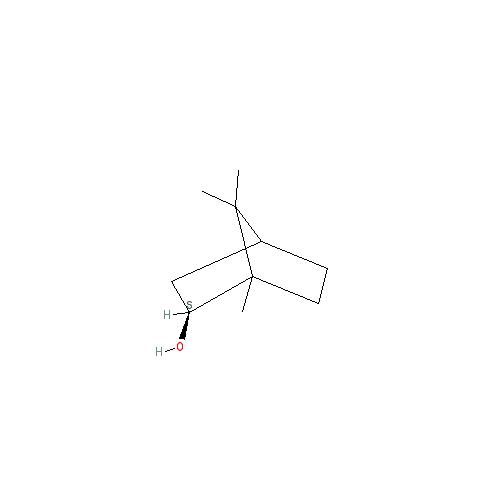
1,7,7-Trimethylbicyclo[2.2.1]heptan-2-ol
Bornyl alcohol · 2-Bornanol · Camphol · Borneo camphor
化学組成 · Constituent
Borneol is a monoterpene alcohol common in pine and Lamiaceae oils. The compound presents very low toxicity risk.
Skin. A 20 percent patch test on 23 male volunteers showed no irritation. (-)-Borneol caused no sensitization in 25 volunteers at 8 percent and 23 volunteers at 20 percent. Two mild sensitizations occurred in a 25-volunteer panel at higher levels.
Oral. Acute oral LD50 in rats is 6.5 g/kg, rabbit dermal LD50 exceeds 2 g/kg. Mouse oral LD50 is 1.06 g/kg.
Neurological. Older literature warnings about nausea, dizziness and convulsions lack support; both (+)- and (-)-borneol have GABAergic activity, anticonvulsant rather than convulsant.
Mutagenicity. Non-mutagenic in the Ames test with and without S9. Non-mutagenic in E. coli. Protective against hydrogen peroxide DNA damage at low doses of 0.5–2.0 mM.
| Sage (Dalmatian) | 1.5 – 23.9 % |
| Thyme (borneol CT) | 20.0 % |
| Inula | 15.3 % |
| African bluegrass | 6.4 – 9.5 % |
| Rosemary | 2.0 – 15.6 % |
| Camphor (Borneo) | 8.3 % |
| Tansy | 7.8 % |
| Southernwood | 7.3 % |
| Citronella | 0 – 6.6 % |
| Sage (Spanish) | 1.5 – 6.4 % |
| Marjoram (Spanish) | 3.8 – 5.9 % |
| Chamomile (Roman) | 0 – 5.0 % |
Both (+)- and (-)-borneol are excreted largely as bornyl glucuronides. The proportion is about 22 percent in rabbits, 50–75 percent in dogs and about 80 percent in humans.
Borneol is an important constituent in East Asian traditional medicine. (-)-Borneol (Ngai camphor) is traditional in Chinese medicine, while (+)-borneol (Borneo camphor) is the form most common in nature.