Farnesol
3,7,11-Trimethyl-2,6,10-dodecatrien-1-ol
(2E,6E)-Farnesol · trans,trans-Farnesol
化学組成 · Constituent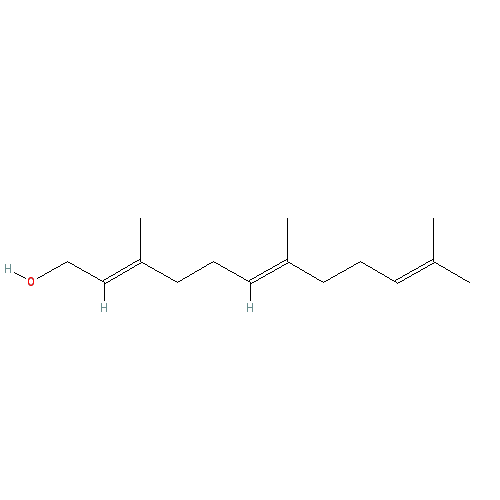
3,7,11-Trimethyl-2,6,10-dodecatrien-1-ol
(2E,6E)-Farnesol · trans,trans-Farnesol
化学組成 · Constituent
Farnesol là một sesquiterpene alcohol xuất hiện chủ yếu trong tinh dầu ambrette và sandalwood Tây Úc. EU liệt kê là một trong 26 chất gây dị ứng hương liệu cần khai báo.
Trên da. Patch test 5 phần trăm ở ba nhóm hơn 300 tình nguyện viên cho thấy không kích ứng và không mẫn cảm. Trong maximation test, 5 phần trăm cá nhân khoẻ mạnh có phản ứng dị ứng với farnesol 10 đến 12 phần trăm. Nguyên chất gây phản ứng ở 14.7 phần trăm cá nhân.
Bệnh nhân viêm da. Tỷ lệ phản ứng với farnesol 5 phần trăm dao động 0.4 đến 1.2 phần trăm trong các nghiên cứu lớn ở châu Âu. Đáng chú ý có vài ca viêm da nách ở phụ nữ trẻ dùng chất khử mùi chứa farnesol.
Đường uống và da. LD50 cấp tính trên chuột vượt 5 g/kg, trên chuột nhắt 8.76 g/kg. LD50 trên thỏ qua da vượt 5 g/kg.
Mạn tính. Nghiên cứu 28 ngày uống 500 đến 1.000 mg/kg/ngày trên chuột không gây độc tính lâm sàng nào. Có tăng trọng lượng thận và gan do cảm ứng enzyme chuyển hoá thuốc.
Đột biến gen và ung thư. Không gây đột biến trong các thử nghiệm Ames và micronucleus. Có hoạt tính chống ung thư đáng kể đối với tế bào ung thư hắc tố, tuyến tuỵ, bạch cầu và ung thư biểu mô vảy miệng.
Farnesol is a sesquiterpene alcohol occurring mainly in ambrette and Western Australian sandalwood oils. The EU lists it as one of 26 fragrance allergens requiring declaration.
Skin. A 5 percent patch test across three groups of more than 300 volunteers produced no irritation or sensitization. In maximation tests, 5 percent of healthy individuals showed allergic reactions to farnesol at 10 to 12 percent. Undiluted material caused reactions in 14.7 percent of individuals.
Dermatitis patients. Reaction rates to 5 percent farnesol vary from 0.4 to 1.2 percent in large European studies. Several cases of axillary dermatitis have been reported in young women using farnesol-containing deodorants.
Oral and dermal. Acute oral LD50 in rats exceeds 5 g/kg, in mice 8.76 g/kg. Acute dermal LD50 in rabbits exceeds 5 g/kg.
Subchronic. A 28-day oral study at 500 to 1,000 mg/kg/day in rats showed no clinical toxicity. Increased kidney and liver weights were attributed to induction of drug-metabolizing enzymes.
Mutagenicity and cancer. Not mutagenic in Ames or micronucleus tests. Significant anticancer activity against melanoma, pancreatic, leukemia and oral squamous carcinoma cells.
| Hoa hồng xạ · Ambrette | 3.4 – 39.0 % |
| Đàn hương Tây Úc · Sandalwood (Western Australian) | 7.9 – 9.3 % |
| Cỏ hồng · Palmarosa | 0.5 – 6.1 % |
| Neroli | 0 – 3.2 % |
| Vassoura | 5.5 % |
| Hoa hồng Nhật · Rose (Japanese) | 3.8 % |
| Riềng nếp · Galangal (greater) | 0 – 3.1 % |
| Gỗ Cabreuva · Cabreuva | 2.5 % |
| Hoa hồng Damask · Rose (Damask) | 0 – 1.5 % |
| Hoa hồng Provence · Rose (Provence) | 0.5 – 1.3 % |
| Hoa huệ Mexico · Tuberose | 1.7 % |
Sau khi uống hỗn hợp các isomer farnesol trên chuột, 80 phần trăm farnesol thu hồi trong huyết tương là isomer (2E,6E). Uống farnesol trong 28 ngày tăng đáng kể hoạt tính của nhiều enzyme gan bao gồm CYP1A, CYP2A1-3, CYP2B1/2, CYP2E1, CYP3A1/2, glutathione reductase và UGT.
After oral administration of a mixture of farnesol isomers in rats, 80 percent of farnesol recovered in plasma was the (2E,6E)-isomer. A 28-day oral course significantly increased the activities of several liver enzymes including CYP1A, CYP2A1-3, CYP2B1/2, CYP2E1, CYP3A1/2, glutathione reductase and UGT.
Farnesol đôi khi được dùng làm chất kháng khuẩn cũng như chất tạo hương trong chất khử mùi. Rủi ro mẫn cảm da thực tế với farnesol trong tinh dầu là thấp.
Farnesol is sometimes used as a bacteriostat as well as a fragrance material in deodorants. The real-world risk of skin sensitization from farnesol in essential oils is low.