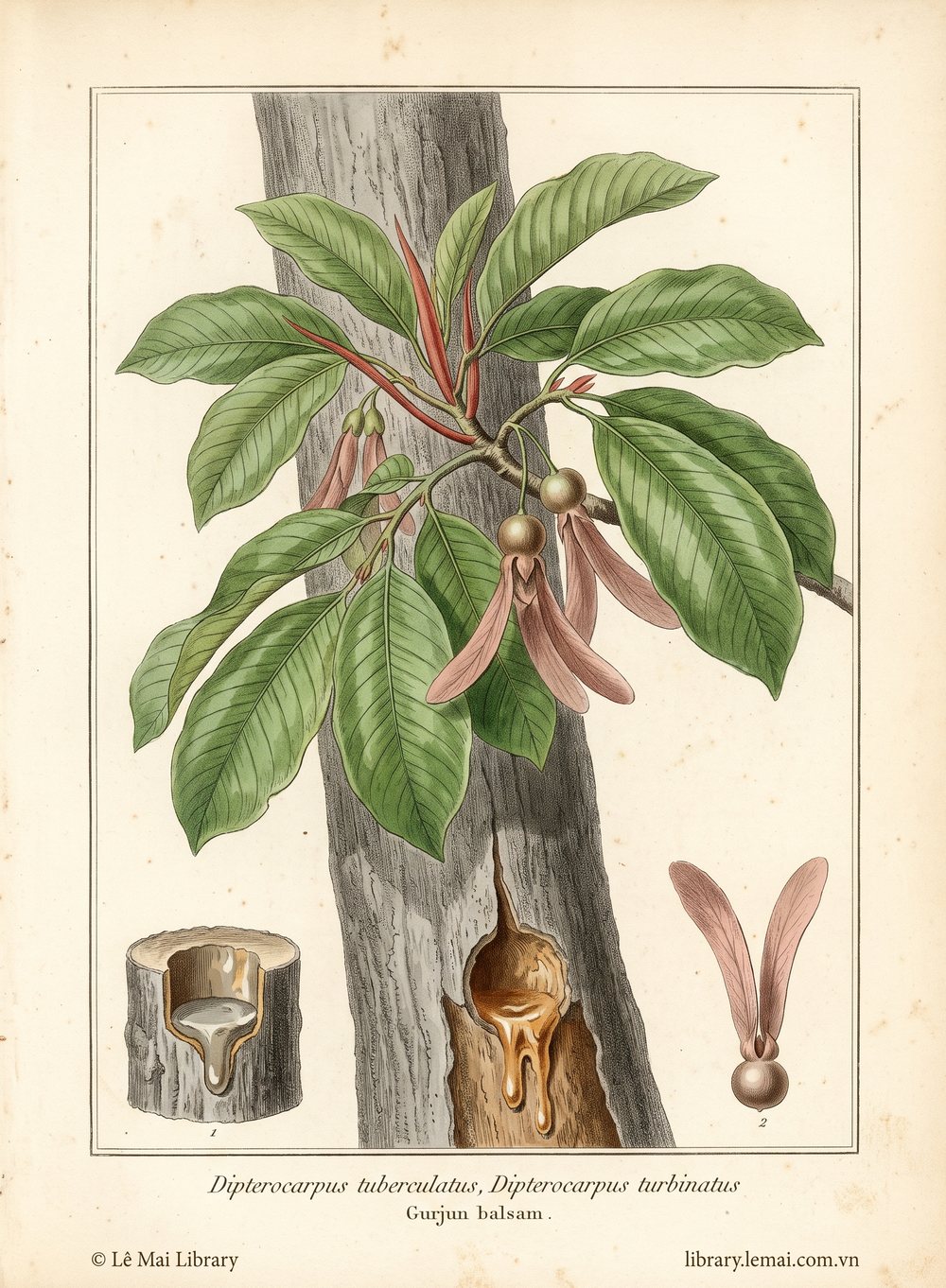
ガージュンバルサム
Gurjun, nhựa
Dipterocarpus tuberculatus, Dipterocarpus turbinatus
Không có chống chỉ định cụ thể trong dữ liệu hiện có.
Tinh dầu chưa pha loãng gây kích ứng nhẹ; ở liều thử nghiệm thấp không kích ứng hay nhạy ứng.
α-Gurjunene (thành tố chính 75 đến 90 phần trăm) chưa được nghiên cứu nhiều về độc tính dài hạn.
No specific contraindications in available data.
Undiluted oil moderately irritating; at low test levels no irritation or sensitization.
α-Gurjunene (the major constituent at 75 to 90 percent) has not been extensively studied for long-term toxicity.
| α-Gurjunene | 20.0 – 90.0 % (theo loài) |
| (−)-allo-Aromadendrene | 4.0 – 6.0 % |
| β-Caryophyllene | 2.0 – 4.0 % |
| Calarene (D. turbinatus) | 15.0 % |
| Copaene (D. turbinatus) | 5.0 % |
Dipterocarpus tuberculatus và Dipterocarpus turbinatus là cây thân gỗ nhiệt đới Đông Nam Á, đặc biệt Myanmar, Thái Lan, Việt Nam, Lào, Indonesia. Cây tiết nhựa balsam thơm khi vết thương.
Tinh dầu cất hơi từ nhựa balsam. Sản lượng giới hạn.
Họ Dipterocarpaceae, cùng họ với Borneo camphor (Dryobalanops aromatica).
Dipterocarpus tuberculatus and Dipterocarpus turbinatus are tropical Southeast Asian trees, particularly in Myanmar, Thailand, Vietnam, Laos, Indonesia. The tree exudes an aromatic balsamic resin when wounded.
The oil is steam-distilled from the resin. Limited availability.
Family Dipterocarpaceae, same family as Borneo camphor (Dryobalanops aromatica).
Đôi khi được dùng làm adulterant cho gỗ cây gỗ hồng đắt tiền hơn vì có ghi chú gỗ ấm tương tự.
Sometimes used as an adulterant for more expensive wood oils due to a similar warm wood note.