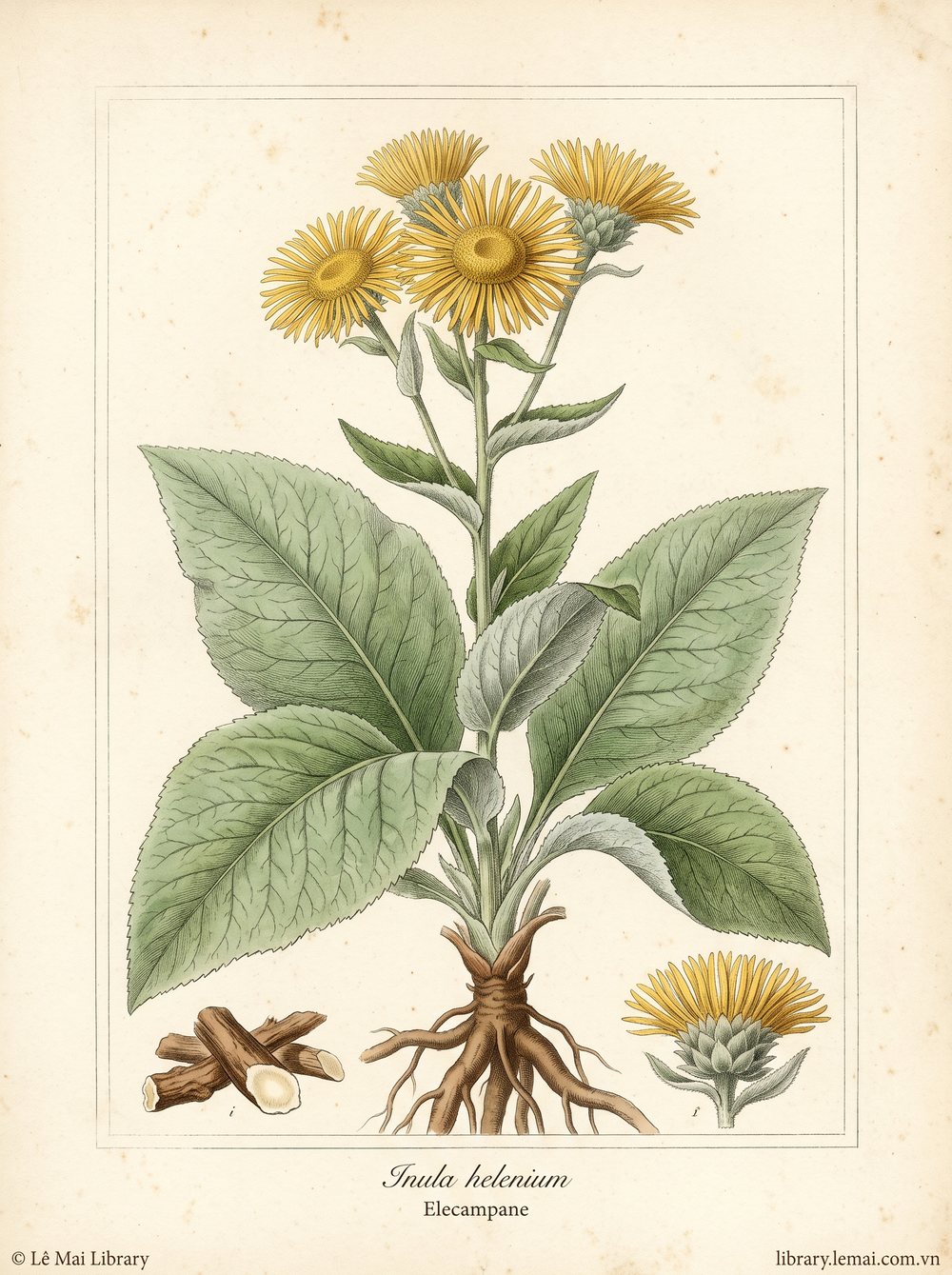
エレカンペーン
Cúc đảng sâm
Inula helenium
Alantroot
Nhạy ứng da rủi ro rất cao.
Chống chỉ định: không dùng trên da.
IFRA khuyến nghị elecampane oil không dùng làm thành tố hương liệu do tiềm năng gây nhạy ứng.
Bị cấm hoàn toàn trong EU và Canada.
Test maximation 4 phần trăm: 23 trên 25 tình nguyện viên gặp phản ứng dị ứng cực kỳ nặng. Alantolactone 1 phần trăm gây phản ứng dương 4 trên 25 bệnh nhân patch test.
Sesquiterpene lactone của họ Compositae (Asteraceae) là nhóm chất gây nhạy ứng nổi tiếng, costus và elecampane là hai ví dụ rõ rệt nhất.
Very high risk of skin sensitization.
Contraindication: should not be used on the skin.
IFRA recommends elecampane oil not be used as a fragrance ingredient due to sensitizing potential.
Prohibited entirely in the EU and Canada.
Maximation test at 4 percent: 23 of 25 volunteers showed 'extremely severe' allergic reactions. Alantolactone at 1 percent caused positive reactions in 4 of 25 patch-test patients.
Sesquiterpene lactones from Compositae (Asteraceae) plants are notorious sensitizers, costus and elecampane are the most pronounced examples.
| Alantolactone | 52.4 % |
| Isoalantolactone | 33.0 % |
| Eudesma-5,7(11)-diene-8β-12 olide | 1.3 % |
| β-Elemene | 1.2 % |
Inula helenium là cây thảo cao của vùng ôn đới châu Âu và châu Á. Rễ to, sấy khô, đã được dùng trong y học truyền thống Hi Lạp và La Mã (Pliny ghi nhận).
Tinh dầu cất hơi từ rễ. Họ Asteraceae.
Elecampane oil thường được dùng làm adulterant cho costus oil. Không nhầm với Inula graveolens, cả hai đều được gọi là 'inula oil' nhưng khác loài.
Inula helenium is a tall perennial of temperate Europe and Asia. The thick dried roots have been used in Greek and Roman traditional medicine (recorded by Pliny).
The oil is steam-distilled from the roots. Family Asteraceae.
Elecampane oil has frequently been used as an adulterant of costus oil. Not to be confused with Inula graveolens, both are called 'inula oil' but they are different species.