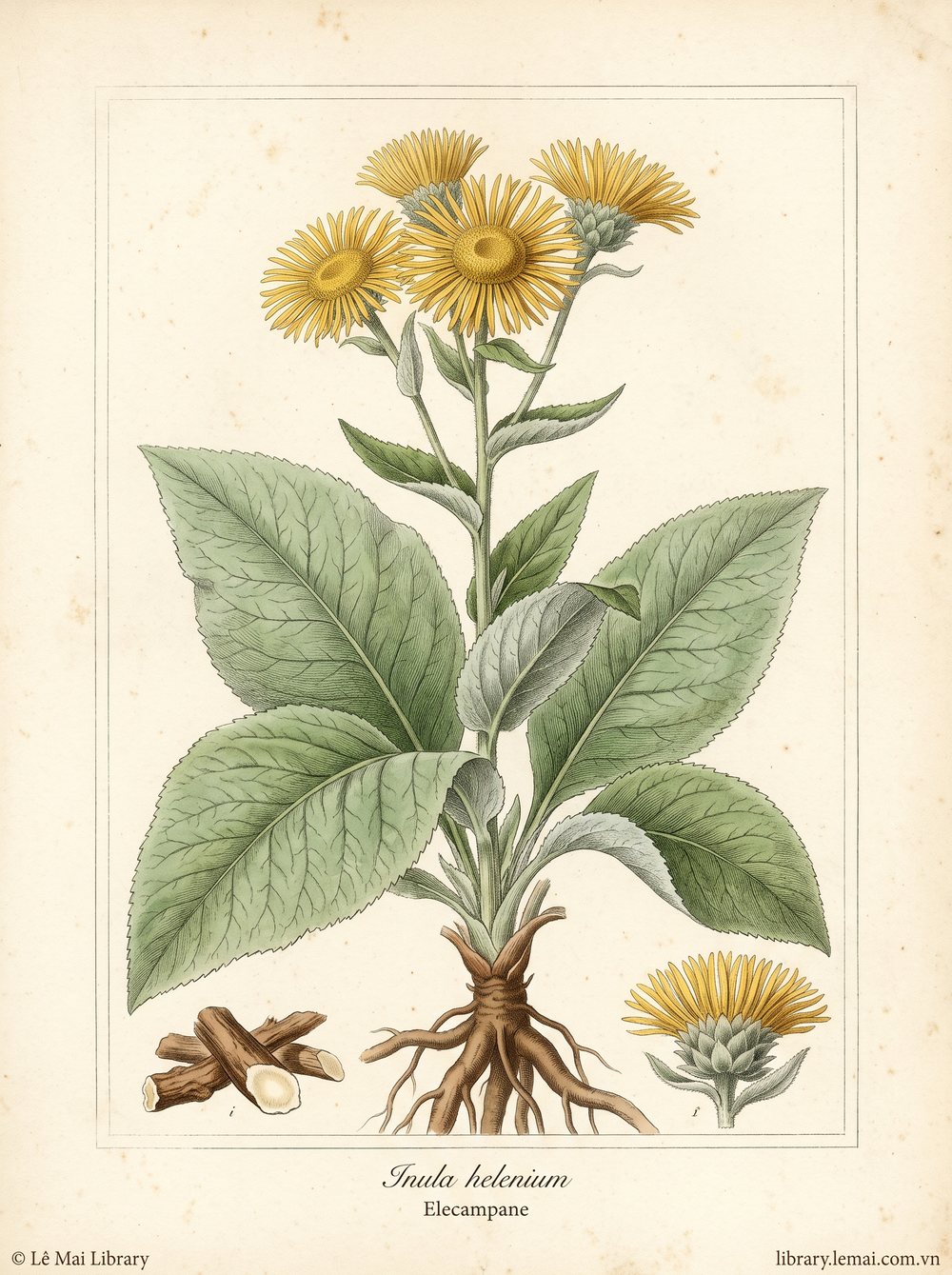
エレカンペーン
Cúc đảng sâm
Inula helenium
Alantroot
Very high risk of skin sensitization.
Contraindication: should not be used on the skin.
IFRA recommends elecampane oil not be used as a fragrance ingredient due to sensitizing potential.
Prohibited entirely in the EU and Canada.
Maximation test at 4 percent: 23 of 25 volunteers showed 'extremely severe' allergic reactions. Alantolactone at 1 percent caused positive reactions in 4 of 25 patch-test patients.
Sesquiterpene lactones from Compositae (Asteraceae) plants are notorious sensitizers, costus and elecampane are the most pronounced examples.
| Alantolactone | 52.4 % |
| Isoalantolactone | 33.0 % |
| Eudesma-5,7(11)-diene-8β-12 olide | 1.3 % |
| β-Elemene | 1.2 % |
Inula helenium is a tall perennial of temperate Europe and Asia. The thick dried roots have been used in Greek and Roman traditional medicine (recorded by Pliny).
The oil is steam-distilled from the roots. Family Asteraceae.
Elecampane oil has frequently been used as an adulterant of costus oil. Not to be confused with Inula graveolens, both are called 'inula oil' but they are different species.