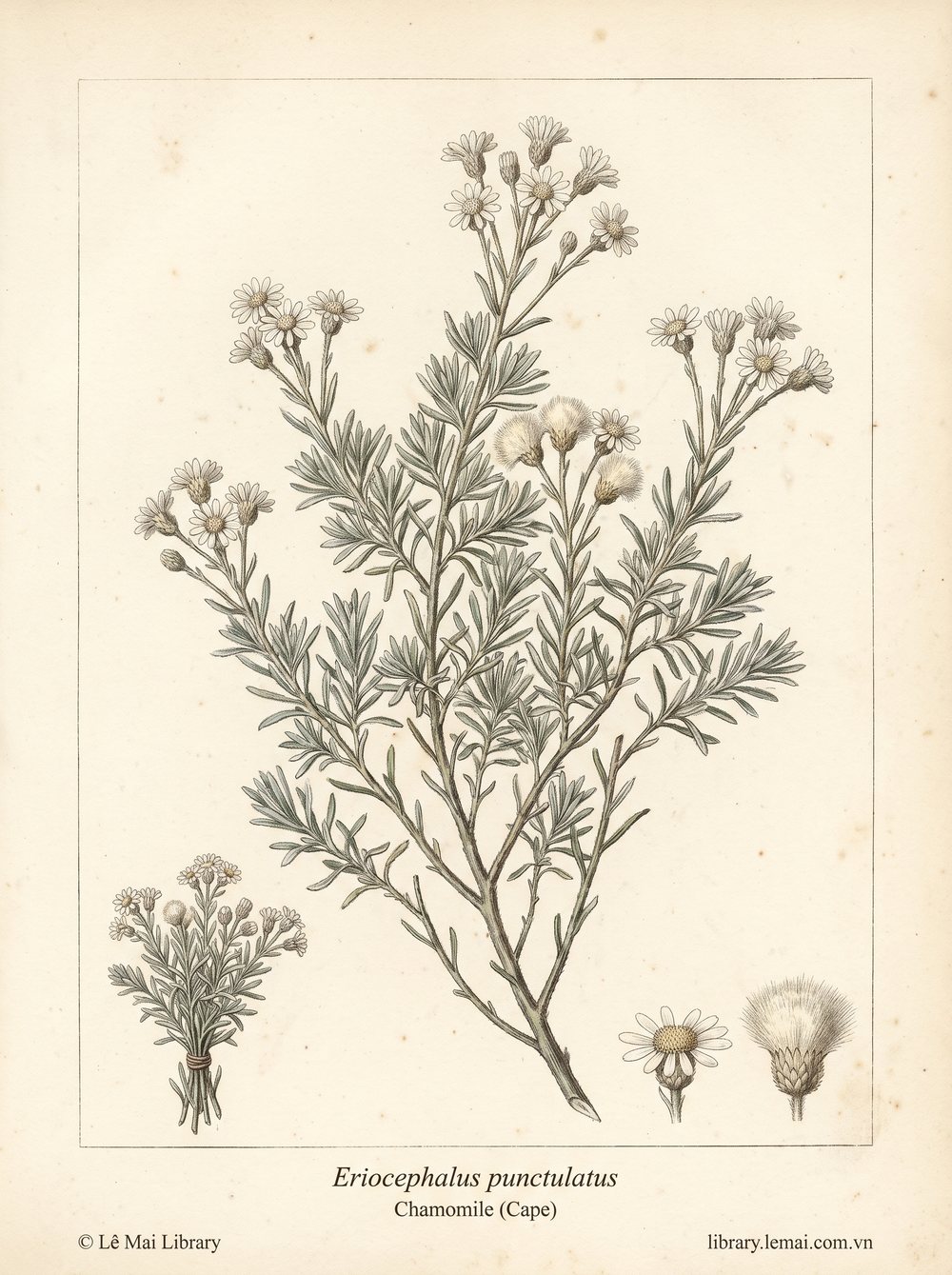
ケープカモミール
Cúc Mũi
Eriocephalus punctulatus
No specific contraindications in available data.
No information on dermal reactions or acute toxicity for Cape chamomile or its major constituents.
Approximately 80 percent of constituents are esters similar to Roman chamomile. The oil is likely to share Roman's low toxicity.
| 2-Methylbutyl 2-methylpropanoate | 23.7 % |
| Linalyl acetate | 14.1 % |
| 2-Methylpropyl 2-methylpropanoate | 8.1 % |
| 2-Methylbutyl 3-methylbutanoate | 6.1 % |
| 3-Methylbutyl angelate | 2.9 % |
| 3-Methylbutyl 2-methylpropanoate | 2.3 % |
| α-Copaene | 2.1 % |
| p-Cymene | 1.6 % |
| Terpinen-4-ol | 1.5 % |
| 2-Methylpropyl 2-methylbutanoate | 1.4 % |
| Borneol | 1.1 % |
| 2-Methylpropyl angelate | 1.0 % |
Eriocephalus punctulatus is a small shrub endemic to the Cape region of South Africa. Small white-petaled flowers around a yellow center, resembling ordinary chamomile despite a different genus.
Limited availability. Prone to oxidation, store in dark, cold conditions.
Family Asteraceae. Same family but different genus from German chamomile (Matricaria) and Roman (Chamaemelum).