Linalool
3,7-Dimethyl-1,6-octadien-3-ol
Linalol · Coriandrol · Licareol
化学組成 · Constituent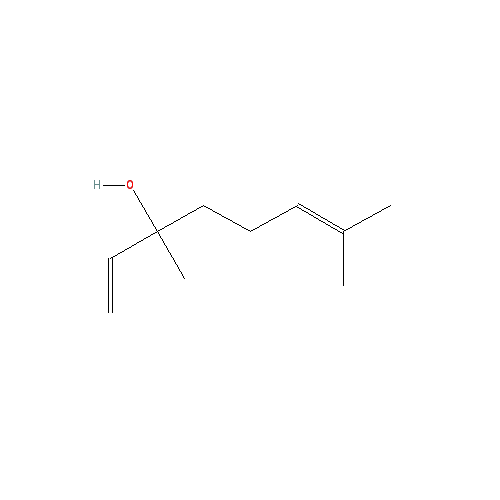
3,7-Dimethyl-1,6-octadien-3-ol
Linalol · Coriandrol · Licareol
化学組成 · Constituent
Linalool is one of the most common essential oil constituents, present in over 200 commercial oils. Pure material is essentially non-reactive to skin, but oxidized linalool can be sensitizing.
Skin. A 20 percent patch test on two panels of 25 volunteers showed no irritation. At 40 percent on 20 dermatitis patients, 97 percent pure linalool was non-irritating. Across pooled clinical studies, 9 of 23,430 dermatitis patients (0.04 percent) reacted positively at concentrations from 5 to 30 percent.
Oxidation. The primary product is linalool hydroperoxide (7-hydroperoxy-3,7-dimethylocta-1,5-diene-3-ol), which is clearly sensitizing. Linalool oxidized for 10 weeks (now 80 percent pure) tested positive. In a study of 1,511 dermatitis patients, 1.3 percent reacted to 2 percent oxidized linalool. Most reactions were mild.
Oral. Acute oral LD50 in rats 2.79 g/kg. High doses cause ataxia and narcosis. Dermal application of 4 g/kg/day to rats for 13 weeks caused decreased weight gain and increased liver weight.
Reproductive. Gavage doses of 250, 500 or 1,000 mg/kg/day to pregnant rats on gestational days 7 to 17 caused no fetal toxicity or teratogenicity. Maternal toxicity NOAEL was 500 mg/kg/day.
Mutagenicity and cancer. Linalool was non-mutagenic in Ames tests. Not carcinogenic in long-term studies. Shows broad anticancer activity in cell lines, particularly against cervical, gastric, skin and leukemia cancers.
| Ho leaf (linalool CT) | 66.7 – 90.6 % |
| Rosewood | 82.3 – 90.3 % |
| Coriander seed | 59.0 – 87.5 % |
| Thyme (linalool CT) | 73.6 – 79.0 % |
| Magnolia leaf | 78.9 % |
| Honeysuckle | 75.0 % |
| Bee balm | 64.5 – 74.2 % |
| Tomar seed | 72.0 % |
| Magnolia flower | 69.9 % |
| Marjoram wild (linalool CT) | 67.7 % |
| Ghandi root | 62.1 % |
| Basil (linalool CT) | 53.7 – 58.3 % |
| Mint (bergamot) | 24.9 – 55.2 % |
| Rosalina | 35.0 – 55.0 % |
| Neroli | 31.4 – 54.3 % |
| Hyssop (linalool CT) | 48.0 – 51.7 % |
| Basil (hairy) | 31.7 – 50.1 % |
| Lavender | 25.0 – 45.0 % |
| Lavender (spike) | 27.2 – 43.1 % |
| Linaloe wood | 30.0 % |
| Ylang-ylang | 0.8 – 30.0 % |
| Khella | 28.8 % |
| Basil (methyl cinnamate CT) | 17.3 – 27.3 % |
| Sanna | 25.6 % |
| Niaouli (linalool CT) | 23.9 % |
| Bergamot | 1.7 – 20.6 % |
| Bergamot (FCF) | 4.0 – 20.0 % |
| Clary sage | 9.0 – 19.3 % |
| Coriander leaf | 4.3 – 17.5 % |
| Sage (wild mountain) | 15.0 % |
| Ho leaf (camphor CT) | 0.5 – 15.0 % |
| Jasmine sambac | 13.9 % |
| Geranium | 0.5 – 13.8 % |
| Fragonia | 11.7 – 12.4 % |
| Sage (Spanish) | 0.2 – 11.2 % |
After oral dosing at 500 mg/kg in rats, 96 percent is excreted within 72 hours. 58 percent through urine, 23 percent through expired air (mainly as CO2), 15 percent through feces. Linalool is oxidized by CYP before being conjugated to a glucuronide.
Linalool induces rat liver enzyme activity. An oral dose of 600 mg/kg/day for 3 days increases hepatic CYP activity by around 50 percent, but activity returns to baseline after 6 days. The compound also induces b-oxidation, part of lipid metabolism.
Linalool has two optical isomers: (S)-(+)-linalool (coriandrol) dominant in coriander, and (R)-(-)-linalool (licareol) dominant in rosewood and ho wood.
Isomeric with geraniol and nerol. One of the most heavily used fragrance constituents in industry, and simultaneously an abundant natural component.