β-Myrcene
7-Methyl-3-methylene-1,6-octadiene
Myrcene
化学組成 · Constituent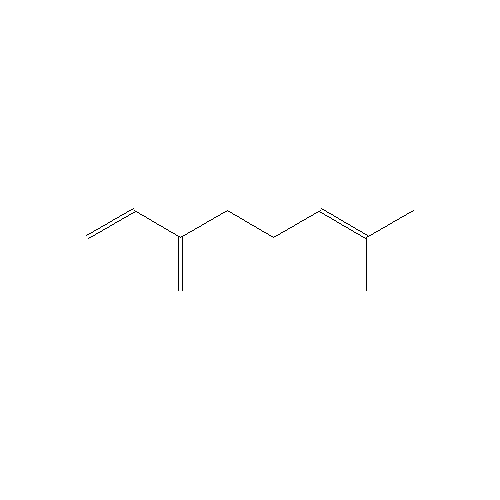
7-Methyl-3-methylene-1,6-octadiene
Myrcene
化学組成 · Constituent
β-Myrcene is an aliphatic monoterpene abundant in many essential oils, particularly the β-myrcene chemotype of rosemary, hop and West Indian bay. The compound is considered non-irritant, non-allergenic and non-toxic at standard use levels.
Skin. Undiluted β-myrcene was moderately irritating to rabbit skin. A 4 percent test on 25 volunteers caused no irritation and no sensitization. In a study of 1,511 dermatitis patients, only 0.07 percent reacted to 3 percent oxidized β-myrcene.
Acute toxicity. Acute oral LD50 in rats exceeded 5 g/kg. The rat oral NOAEL is 300 mg/kg. In a 14-week high-dose study (250 to 4,000 mg/kg/day), 39 of 40 high-dose rats died within the first week. The 250 mg/kg low dose was safe for hematology.
Reproductive. Oral doses up to 2 g/kg in rats and 1 g/kg in mice had no effect on reproductive organ weight, sperm count or estrus cycle. Rat reproductive NOAEL was 250 mg/kg.
Mutagenicity. Non-mutagenic in Ames tests. Shows strong antimutagenic activity through concentration-dependent PROD inhibition. May reduce genotoxicity of DMBA, benzo[a]pyrene and cyclophosphamide.
Cancer. Renal tubule lesions in male rats, the male rat-specific pattern also seen with (+)-limonene and 1,8-cineole, not relevant to humans. Some liver tumors in male mice at high doses, not mirrored in rats. The massive doses and modest purity of β-myrcene used in the study make data difficult to extrapolate to humans.
| Cape May | 43.8 % |
| Celery leaf | 33.6 % |
| Hop | 25.4 % |
| Bay (West Indian) | 6.4 – 25.0 % |
| Parsley leaf | 7.8 – 23.8 % |
| Juniperberry | 0 – 22.0 % |
| Pepper (pink) | 5.0 – 20.4 % |
| African bluegrass | 15.4 – 20.2 % |
| Lemongrass | 5.6 – 19.2 % |
| Pepper (Sichuan) | 16.4 % |
| Lavender cotton | 3.6 – 15.0 % |
| Tansy (blue) | 1.1 – 13.8 % |
| Pine (white) | 4.7 – 13.1 % |
| Mastic | 0.2 – 12.3 % |
| Myrtle (honey) | 10.9 % |
| Pteronia | 10.3 % |
| Myrtle (bog) | 9.5 % |
| Goldenrod | 9.4 % |
| Grindelia | 14.0 – 26.0 % |
| Verbena (honey) | 4.7 – 8.3 % |
| Ravensara leaf | 5.0 – 7.3 % |
| Yarrow (chamazulene CT) | 7.0 % |
| Pine (dwarf) | 0.5 – 7.0 % |
| Pine (grey) | 4.1 – 6.1 % |
| Angelica root | 1.6 – 5.5 % |
| Spruce (Norway) | 3.0 – 5.2 % |
| Pine (red) | 4.3 – 5.0 % |
β-Myrcene given intragastrically for 20 consecutive days is mainly metabolized to a pair of glycols, via epoxidation and hydration, followed by oxidation to a corresponding pair of hydroxycarboxylic acids. In rats given 1 g/kg, blood levels at 60 minutes were 14.1 µg/mL with a half-life of 285 minutes.
β-Myrcene is an inducer of isoenzymes belonging to the CYP2B subfamily. The compound prolongs pentobarbital-induced sleeping time in rats, probably by inhibiting the barbiturate's metabolism by CYP.
Only the β-isomer of myrcene occurs in essential oils. The compound has been identified in over 200 plant species and is present in emissions from many trees.
β-Myrcene serves as an important industrial precursor for synthesizing menthol, geraniol and other terpenes.