Terpineol
(1S)-α,α,4-Trimethyl-3-cyclohexene-1-methanol
α-Terpineol · p-Menth-1-en-8-ol
化学組成 · Constituent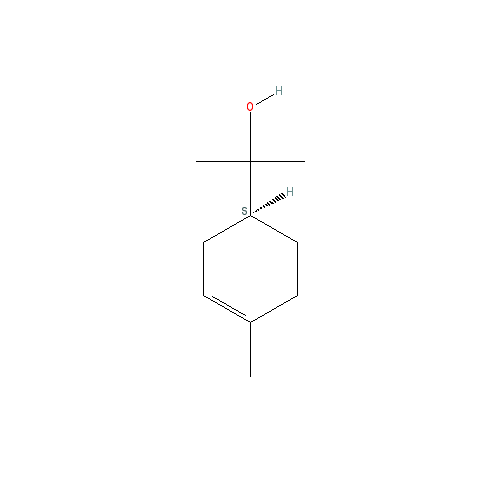
(1S)-α,α,4-Trimethyl-3-cyclohexene-1-methanol
α-Terpineol · p-Menth-1-en-8-ol
化学組成 · Constituent
α-Terpineol is the predominant terpineol isomer in essential oils and the only form individually studied. Available data indicates it is safe at standard concentrations.
Skin. Undiluted mixed isomer terpineol was moderately irritating to rabbit skin. At 12 percent on 25 volunteers it was not sensitizing. At 5 percent on 1,606 dermatitis patients, 1 allergic reaction occurred. Among 1,200 patients, 2 reacted at 0.17 percent. In 100 patients at 5 percent there were no reactions. α-Terpineol also reduces edema in contact hypersensitivity and is non-phototoxic.
Oral. Acute oral LD50 in rats was 4.3 g/kg for the mixed isomer. Acute dermal LD50 in rabbits exceeded 3 g/kg.
Reproductive. α-Terpineol showed anti-estrogenic activity in an in vitro MCF-7 cell assay.
Mutagenicity. Inconsistent results, mostly non-mutagenic.
Cancer. α-Terpineol shows in vitro cytotoxicity against several human cancer cell lines including leukemia, cervical, breast, ovarian, prostate and lung cancers.
| Orange flower water (absolute) | 20.0 – 23.5 % |
| Eucalyptus (radiata) | 0 – 15.2 % |
| Cedarwood (Port Orford) | 14.3 % |
| Lime (distilled) | 5.4 – 12.7 % |
| Palo santo | 7.1 – 10.9 % |
| Thyme (borneol CT) | 10.0 % |
| Niaouli (cineole CT) | 4.0 – 10.0 % |
| Galangal (greater) | 2.3 – 9.3 % |
| Cajuput | 6.5 – 8.7 % |
| Linaloe wood | 8.5 % |
| Eucalyptus (camaldulensis) | 0 – 8.4 % |
| Marjoram (sweet) | 3.8 – 8.3 % |
| Tea tree | 1.5 – 8.0 % |
| Lemon (expressed) | 0.1 – 8.0 % |
| Cardamon (black) | 7.9 % |
| Narcissus | 0.3 – 7.0 % |
| Orange leaf | 2.1 – 6.8 % |
| Sugandha | 6.6 % |
| Neroli | 1.1 – 5.8 % |
| Sage (African wild) | 5.7 % |
| Fragonia | 5.6 – 5.7 % |
| Rosewood | 0.5 – 5.4 % |
| Galangal (lesser) | 5.0 % |
α-Terpineol forms a glucuronide conjugate in rabbits and is excreted mainly unchanged in guinea pig urine. The major urinary metabolite in both rat and human is p-menthan-1,2,8-triol, mostly free and partly conjugated. Acidic metabolites have also been detected.
Terpineol exists as four isomers α, β, γ and δ. Only Spanish marjoram contains more of a non-α isomer. RIFM toxicity data is based on a mixed isomer sample and applies to terpineol generally.