(E)-Geranyl acetate
(2E)-3,7-Dimethyl-2,6-octadien-1-yl ethanoate
trans-Geranyl acetate · Acetic acid trans-geranyl ester
化学組成 · Constituent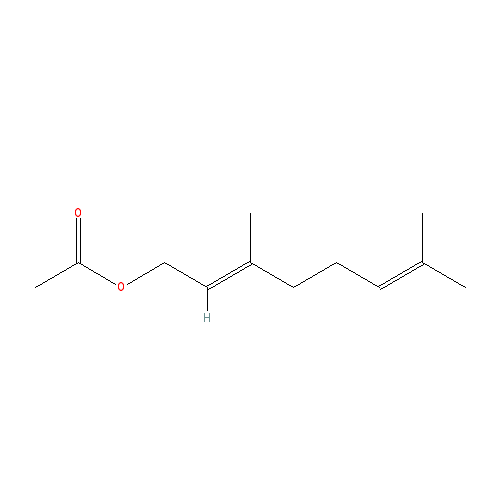
(2E)-3,7-Dimethyl-2,6-octadien-1-yl ethanoate
trans-Geranyl acetate · Acetic acid trans-geranyl ester
化学組成 · Constituent
(E)-Geranyl acetate is the acetate ester of geraniol, widely occurring in floral and herbaceous essential oils.
Skin. A 4 percent patch test on 25 volunteers produced no sensitization. Two cases of contact dermatitis patch-tested at 1 percent showed mild positive responses.
Oral. Acute oral LD50 in rats is 6.33 g/kg.
Subchronic. Rats fed 10,000 ppm in the diet for 17 weeks showed no observable effects.
Mutagenicity and cancer. Not mutagenic in the Ames test. In a two-year study in rats and mice, food-grade geranyl acetate (71 percent geranyl acetate, 29 percent citronellyl acetate) was not considered carcinogenic.
| Thyme (geraniol CT) | 36.5 % |
| Jamrosa | 18.0 – 25.0 % |
| Eucalyptus (macarthurii) | 18.8 – 21.8 % |
| Ylang-ylang | 1.2 – 11.0 % |
| Palmarosa | 0.5 – 10.7 % |
| Citronella | 2.1 – 5.1 % |
| Rose (Damask) | 0 – 4.7 % |
| Geranium | 0 – 4.4 % |
| Neroli | 0.7 – 4.1 % |
| Lemon balm (Australian) | 4.0 % |
| Lemongrass | 0.1 – 4.0 % |
| Lemon leaf | tr – 4.0 % |
| Western red cedar | 0.1 – 3.9 % |
| Carrot seed | 0 – 3.7 % |
| Linaloe wood | 3.5 % |
| Melissa | 0.7 – 3.3 % |
| Coriander seed | 0 – 3.1 % |
| Myrtle | 1.4 – 2.9 % |
| Thyme (lemon) | 2.4 % |
| Mint (bergamot) | 0.7 – 1.8 % |
| Cananga | 1.5 % |
| Clary sage | tr – 1.2 % |
| Lavandin | 0 – 1.2 % |
| Pine (ponderosa) | 1.1 % |
| Combava fruit | 1.0 % |
| Myrtle (honey) | 1.0 % |
| Skimmia | 2.5 % |
(E)-Geranyl acetate contributes a soft and sweet rose note in rose, palmarosa and geranium oils, tempering the sharper character of free geraniol.