Nerolidol
3,7,11-Trimethyl-1,6,10-dodecatrien-3-ol
Peruviol
化学組成 · Constituent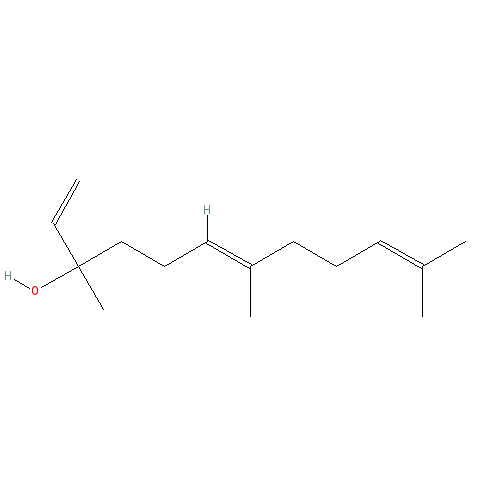
3,7,11-Trimethyl-1,6,10-dodecatrien-3-ol
Peruviol
化学組成 · Constituent
Nerolidol is a sesquiterpene alcohol present in many essential oils, particularly high in niaouli chemotypes, cabreuva and siam wood. The compound is non-irritating, non-allergenic and non-toxic.
Skin. In a modified Draize procedure on guinea pigs, nerolidol was non-sensitizing at 20 percent. Undiluted nerolidol was non-irritating to rabbit skin, and at 4 percent on 25 volunteers it caused no irritation and no sensitization. Among 102 dermatitis patients sensitive to Peru balsam, 3 reacted positively to 1 percent nerolidol.
Acute toxicity. Acute oral LD50 in rats exceeded 5 g/kg. Acute dermal LD50 in rabbits exceeded 5 g/kg.
Reproductive. In an ex vivo assay, nerolidol did not bind to estrogen receptors in female rat uterus tissue.
Mutagenicity. Neither (Z)-nerolidol nor mixed-isomer nerolidol was mutagenic in S. typhimurium strains TA98 and TA100. Nerolidol was weakly genotoxic in mouse peripheral blood leucocytes and hepatocytes, and genotoxic in a mouse micronucleus test.
Cancer. Shows significant anticancer activity, inhibiting azoxymethane-induced colon cancer in male F344 rats. Moderately cytotoxic in vitro against two human carcinoma cell lines.
| Niaouli (nerolidol CT) | 75.7 – 92.5 % |
| Cabreuva | 65.0 – 80.0 % |
| Niaouli (linalool CT) | 61.1 % |
| Siam wood | 35.5 % |
| Vassoura | 20.0 – 30.0 % |
| Cedrela | 8.0 % |
| Orange flower | 0 – 7.6 % |
| Niaouli (viridiflorol CT) | 3.0 – 6.0 % |
| Balsam poplar | 5.8 % |
| Neroli | 1.3 – 4.0 % |
| Fern (sweet) | 3.7 % |
| Cubeb | 1.4 – 3.5 % |
| Bakul | 3.2 % |
| Cardamon | 0.1 – 2.7 % |
| Chaste tree | 0 – 2.5 % |
| Southernwood | 2.2 % |
| Lantana | 2.3 % |
| Damiana | 2.2 % |
| Honeysuckle | 2.2 % |
| Sandalwood (Western Australian) | 0 – 2.2 % |
| Ambrette | 0.1 – 2.0 % |
| Peru balsam | 2.0 % |
| Spikenard | 1.9 % |
| Myrtle (bog) | 1.5 % |
| Amyris | 0.4 – 1.1 % |
In an uptake study using human skin, 39.6 percent of the applied nerolidol was found in the stratum corneum.
Nerolidol has several optical and geometric isomers. In nature, (E)-nerolidol dominates niaouli oils while (Z)-nerolidol is characteristic of cabreuva.
Nerolidol is an effective skin permeation enhancer and has been studied for improving transdermal drug delivery.