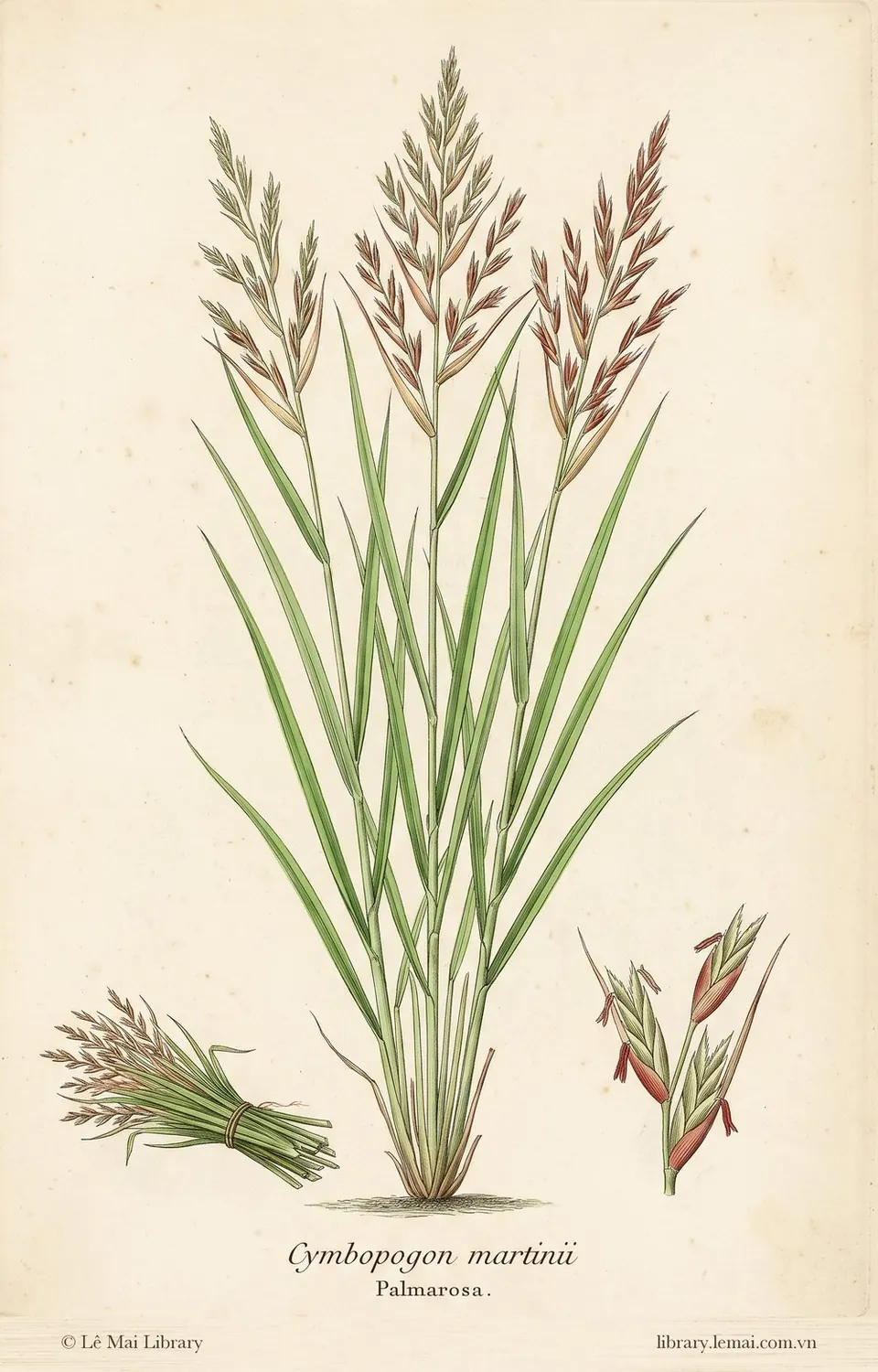
パルマローザ
Cỏ hồng
Cymbopogon martinii
Indian geranium, Rosha grass
Palmarosa essential oil is steam-distilled from the leaves and aerial parts of Cymbopogon martinii, a tropical Indian grass in the same genus as lemongrass and citronella. It is produced mainly in India, Brazil and Nepal. It has a rose-like aroma, and its main component is geraniol (70.0 to 85.0%). The risk of skin sensitization is low, and the maximum dermal level is 6.5%.
Updated 3 Nov 2026 · Lê Mai Team
Geraniol comprises 70-85 percent. Low skin sensitization risk.
Oxidized geraniol may sensitize. Store properly.
No data indicates hazard in pregnancy.
| Geraniol | 70.0 – 85.0 % |
| Geranyl acetate | 5.0 – 13.0 % |
| Linalool | 2.0 – 4.5 % |
| β-Caryophyllene | 1.0 – 3.0 % |
| β-Ocimene | 0.5 – 3.0 % |
Cymbopogon martinii is a tropical Indian grass, same genus as lemongrass and citronella.
The essential oil is distilled from aerial parts, rich in geraniol, with a rose-like aroma.
Main production: India, Brazil, Nepal.
Family Poaceae.
Also called 'Indian geranium' for its rose- and geranium-like aroma. Used as a rose substitute in inexpensive perfumery.
In cosmetics and soap, palmarosa is widely used for soft floral-citrus notes.
Buy Palmarosa Essential Oil No.063