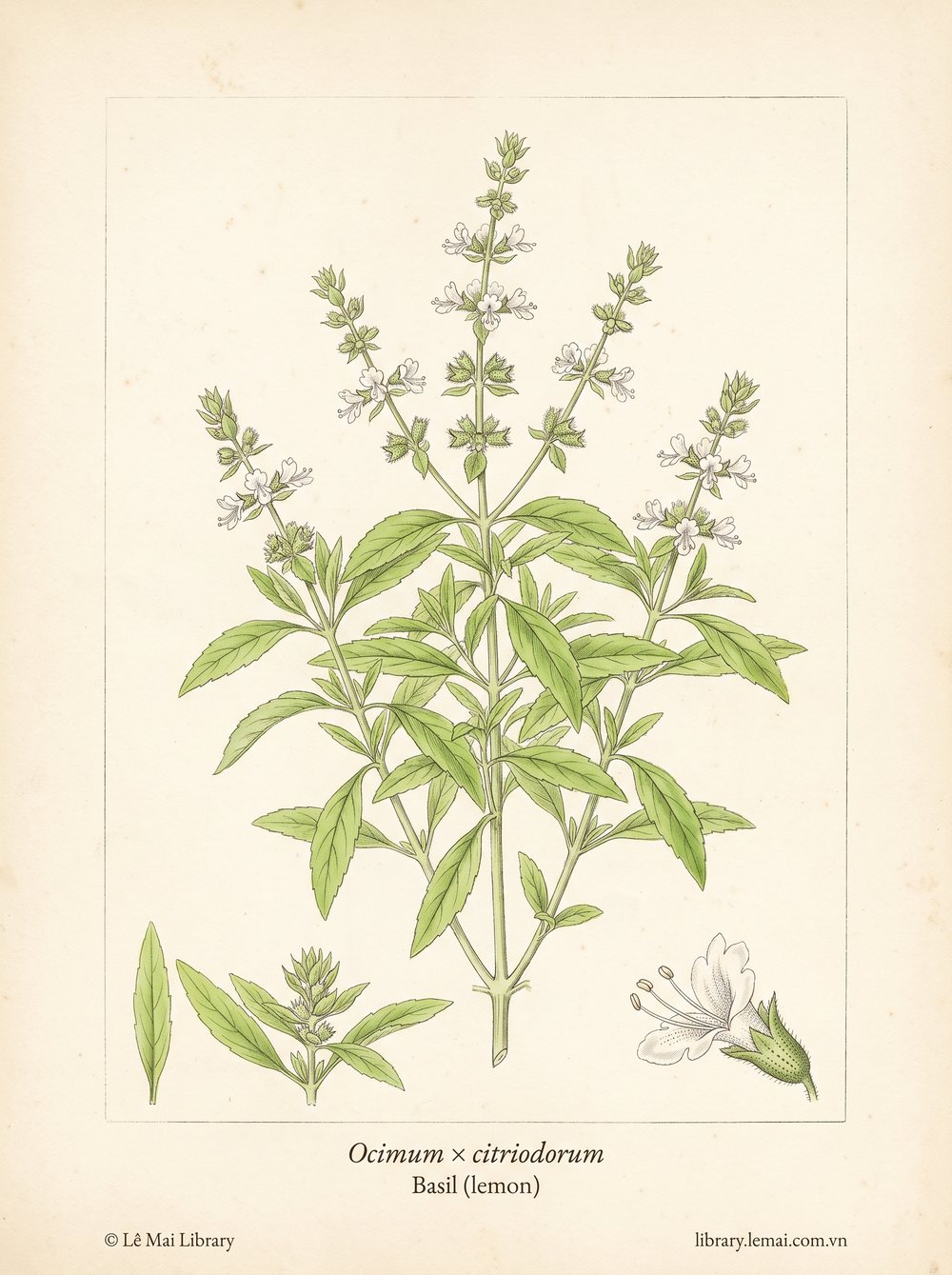
バジル レモン
Húng quế chanh
Ocimum × citriodorum
Lemon basil
Potentially teratogenic due to citral content. Avoid undirected oral use during pregnancy.
Low risk of skin sensitization. Citral can produce sensitization reactions on patch testing above 0.5 percent.
Oral: caution with diabetes medication, as citral lowers insulin and glucose in animal studies. Caution with drugs metabolized by CYP2B6.
Avoid on hypersensitive, diseased or damaged skin, and on children under 2 years.
| Geranial | 23.3 – 25.1 % |
| Neral | 16.0 – 17.1 % |
| Nerol | 13.0 – 15.3 % |
| Linalool | 5.0 – 7.8 % |
| (E)-α-Bisabolene | 5.3 – 6.2 % |
| Geraniol | 4.3 – 4.7 % |
| (E)-β-Caryophyllene | 3.8 – 4.5 % |
| Menthol | 3.8 – 4.4 % |
| Borneol | 1.7 – 2.7 % |
| Germacrene D | 2.4 – 2.6 % |
Ocimum × citriodorum is a hybrid of Ocimum basilicum and Ocimum americanum, with a distinct lemon note from citral.
The oil is steam-distilled from the leaves. Limited availability.
Family Lamiaceae. Lemon basil leaves are common in Thai and Vietnamese cuisine, where the plant is called hung que chanh.
High oxidation potential. Store in dark, sealed, refrigerated container. Add an antioxidant to preparations containing lemon basil.