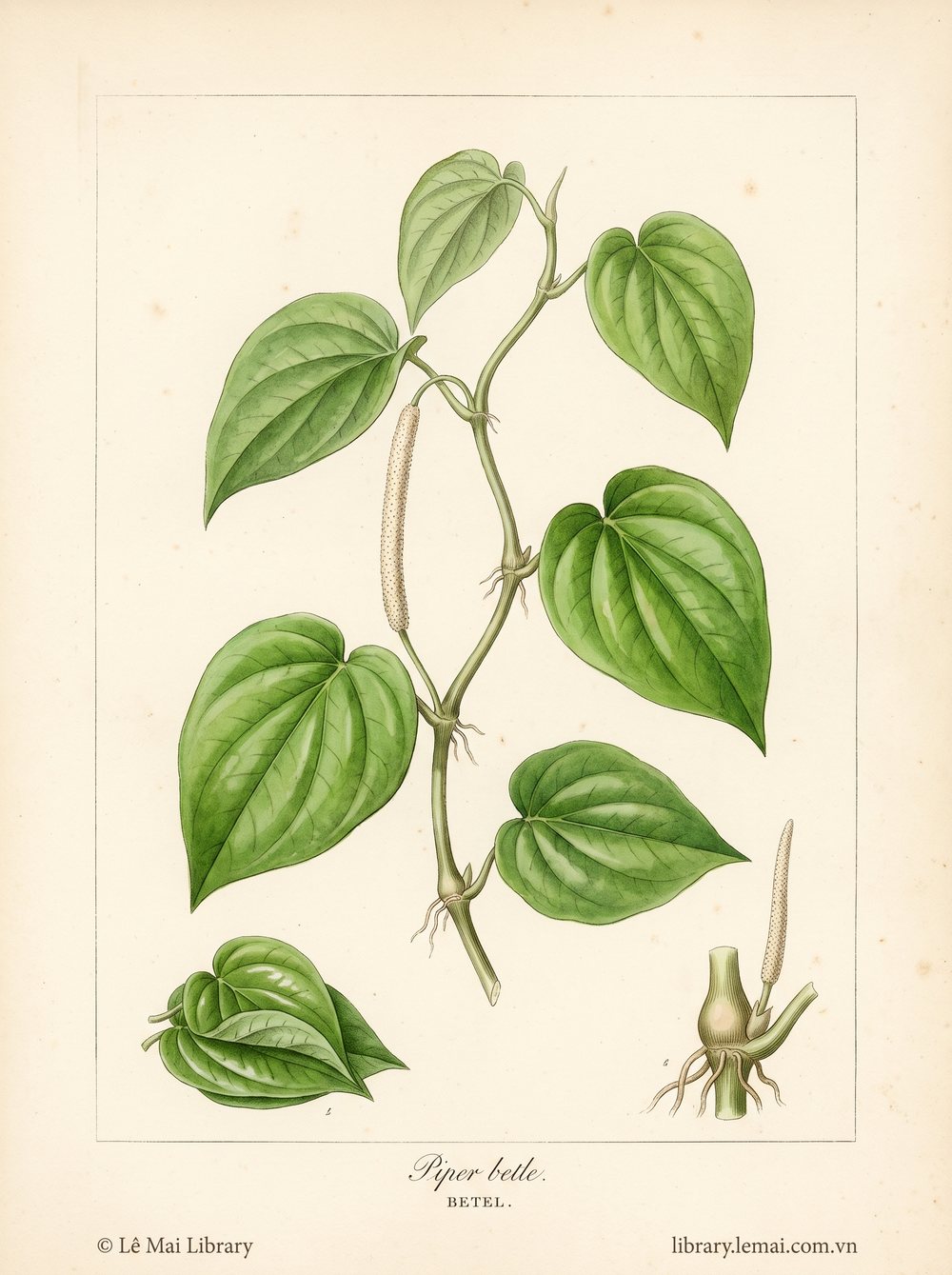
ベテル
Trầu (lá)
Piper betle
Betel leaf
Potentially carcinogenic due to safrole, estragole and methyleugenol content. Low risk of skin sensitization. Low risk of mucous membrane irritation.
Should not be taken orally.
Maximum dermal use level 0.1 percent based on 45.3 percent safrole, 4.8 percent estragole and 1.7 percent methyleugenol, with dermal limits of 0.05, 0.12 and 0.02 percent respectively.
Evidence is mixed for betel leaf extracts (antimutagenic and anticarcinogenic in some studies, opposite in others), but the essential oil itself contains clear carcinogens at high variation.
| Safrole | 6.5 – 45.3 % |
| Eugenol | 20.5 – 33.2 % |
| α-Terpinyl acetate | 6.8 – 11.0 % |
| Isoeugenol | 0 – 10.6 % |
| (E)-Anethole | 0 – 7.8 % |
| β-Caryophyllene | 0 – 7.8 % |
| Dodecanal | 0 – 7.1 % |
| β-Selinene | 0 – 6.4 % |
| Sabinene | 0 – 6.1 % |
| Estragole | 0 – 4.8 % |
| α-Cubebene | 0 – 4.4 % |
| Methyleugenol | 0.3 – 1.7 % |
Piper betle is a tropical Asian climbing vine. The leaves are traditionally chewed with lime and areca nut as betel quid.
Many cultivars exist, each with distinct chemistry. Commercial cultivars distilled for essential oil are mostly the eugenol-rich types.
Other cultivars contain chavibetol, chavicol, isoeugenol, or eugenyl acetate as the major constituent.
Betel quid chewing is a deep cultural practice across Southeast Asia. The essential oil is a different object, a concentrated form of constituents present in the whole leaf at dilution.