Phenylethyl isothiocyanate
(2-Isothiocyanatoethyl)benzene
2-Phenylethyl isothiocyanate · β-Phenylethyl isothiocyanate · Phenethyl isothiocyanate · PEITC
化学組成 · Constituent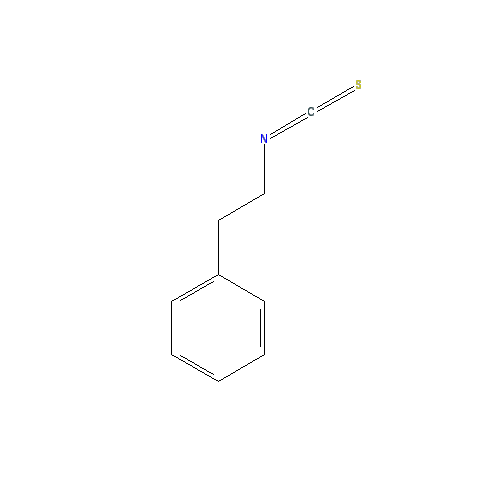
(2-Isothiocyanatoethyl)benzene
2-Phenylethyl isothiocyanate · β-Phenylethyl isothiocyanate · Phenethyl isothiocyanate · PEITC
化学組成 · Constituent
PEITC chỉ sinh ra khi rễ cải ngựa hoặc hạt mù tạt được nghiền. Hợp chất là chất kích ứng mạnh, không phù hợp cho sản phẩm bôi ngoài da hoặc mỹ phẩm.
Đột biến gen. PEITC gây sai lệch nhiễm sắc thể ở dòng tế bào Indian Muntjac ở nồng độ có thể liên quan đến rủi ro cho người ngay cả ở mức trong khẩu phần. Ở 5 mM trở lên, PEITC gây tổn thương DNA trong tế bào gan người HepG2.
Ung thư. Liều uống trên 0.01 phần trăm trên chuột đực thúc đẩy ung thư bàng quang và yếu hơn là ung thư gan. Mặt khác, PEITC bảo vệ chuột khỏi ung thư phổi do nitrosamine và NNK, và ức chế ung thư đại tràng và tiền liệt tuyến trong nhiều mô hình. Hoạt tính hai mặt khiến hợp chất được xem là ứng viên hứa hẹn cho điều trị ung thư nhưng không an toàn để dùng thường xuyên.
Cơ chế. Trong tế bào ung thư, PEITC kích hoạt apoptosis qua nhiều con đường gồm caspase-3 và p53.
PEITC is only released when horseradish root or mustard seed is crushed. It is a strong irritant unsuitable for topical or cosmetic use.
Mutagenicity. PEITC caused chromosome aberrations in an Indian Muntjac cell line at concentrations potentially relevant to human dietary exposure. At 5 mM and above, PEITC itself caused DNA damage in human HepG2 hepatoma cells.
Cancer. Oral doses above 0.01 percent in male rats promoted urinary bladder carcinogenesis and more weakly promoted liver tumors. On the other hand, PEITC protected rodents against nitrosamine and NNK induced lung tumors and inhibited prostate, colon and lung cancers in numerous models. This dual activity makes the compound a promising candidate for cancer therapy but unsuitable for routine consumer exposure.
Mechanism. In cancer cells, PEITC induces apoptosis through multiple pathways including caspase-3 and p53 activation.
| Cải ngựa · Horseradish | 38.4 – 51.3 % |
| Mù tạt · Mustard | 2.4 – 5.0 % |
PEITC được chuyển hoá thành axit mercaptopyruvic và dạng liên hợp N-acetylcysteine. Quá trình chuyển hoá khác nhau ở các loài động vật thí nghiệm theo độ tuổi.
PEITC is metabolized to mercaptopyruvic acid and the N-acetylcysteine conjugate. Metabolism differs in experimental animals according to their age.
PEITC là một trong những isothiocyanate được nghiên cứu nhiều nhất với hoạt tính chống ung thư đa hướng. Ở khẩu phần ăn từ rau họ cải, nồng độ rất thấp và khác xa nồng độ trong tinh dầu cải ngựa.
PEITC is one of the most extensively studied isothiocyanates for its broad anticancer activity. Dietary exposure from Brassicaceae vegetables is far lower than concentrations found in horseradish oil.