Bergamottin
5-((E)-3,7-Dimethyl-2,6-octadien-1-yloxy)-furano[3,2-g]benzopyran-7-one
5-Geranoxypsoralen · 5-GOP · 5-Geranoxy-6,7-furanocoumarin
化学組成 · Constituent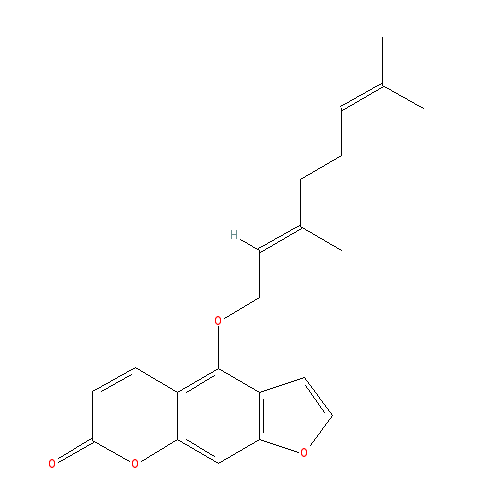
5-((E)-3,7-Dimethyl-2,6-octadien-1-yloxy)-furano[3,2-g]benzopyran-7-one
5-Geranoxypsoralen · 5-GOP · 5-Geranoxy-6,7-furanocoumarin
化学組成 · Constituent
Bergamottin is a psoralen present in citrus essential oils. The compound itself is only mildly phototoxic, not photomutagenic in recent in vivo testing, but falls within the furocoumarin group subject to a collective limit.
Skin and photobiology. Bergamottin photosensitizes cultured mammalian cells and forms at least four photobiologically active degradation products. However, in vivo dermal studies show no phototoxicity. Phototoxic activity is detectable only above the in vitro V79 threshold.
Metabolism. Bergamottin inhibits CYP3A (IC50 22 μM), CYP3A4 (IC50 13.63 μM), and is a potent inhibitor of CYP1A1 and CYP1A2.
Mutagenicity. Non-mutagenic in five Salmonella strains with or without UVA. No photomutagenic activity in HPRT or micronucleus assays.
Cancer. Bergamottin inhibits tumor initiation by B[a]P. The compound prevents B[a]P and DMBA induced DNA adduct formation in MCF-7 human breast cancer cells via inhibition of multiple human CYPs.
| Lime (expressed) | 1.7 – 3.0 % |
| Bergamot | 0.68 – 2.75 % |
| Bergamot (FCF) | 0 – 1.625 % |
| Lemon (expressed) | 0.16 – 0.54 % |
| Grapefruit | < 0.11 % |
Bergamottin metabolism may differ between rats and humans. The compound reduces formation of B[a]P metabolites and inhibits B[a]P induced DNA adducts when applied topically 5 minutes prior to an initiating dose.
Bergamottin is one of several psoralens in citrus oils. The compound's interaction with drug metabolism through CYP inhibition underlies grapefruit juice drug interactions.
The 1 ppm limit applies to total furocoumarins in cosmetics, not bergamottin alone.