(E)-Geranial
(2E)-3,7-Dimethyl-2,6-octadienal
(E)-Citral · trans-Citral · α-Citral · Citral a
化学組成 · Constituent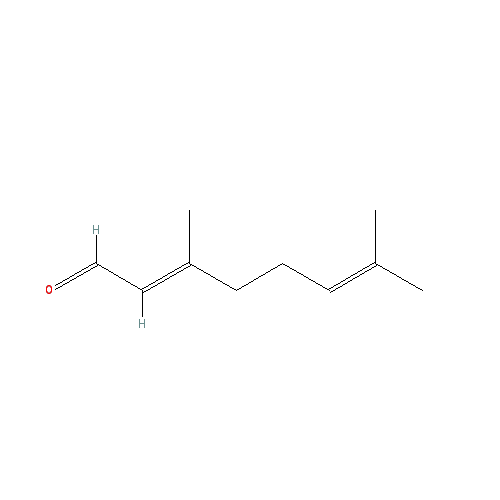
(2E)-3,7-Dimethyl-2,6-octadienal
(E)-Citral · trans-Citral · α-Citral · Citral a
化学組成 · Constituent
(E)-Geranial is one of the two main isomers of citral, the dominant constituent in lemongrass, may chang and melissa oils. As an aldehyde, the compound has potential for skin sensitization.
Specific safety data for geranial are limited, but as a natural component of citral the safety restrictions for citral also apply to geranial.
The EU lists citral (geranial plus neral) as one of 26 fragrance allergens requiring declaration. IFRA restricts citral in leave-on products due to skin sensitization risk.
| Myrtle (lemon) | 46.1 – 60.7 % |
| Lemongrass | 36.7 – 55.9 % |
| Tea tree (lemon-scented) | 45.4 % |
| May chang | 37.9 – 40.6 % |
| Lemon leaf | 10.9 – 39.0 % |
| Verbena (lemon) | 29.5 – 38.3 % |
| Melissa | 12.5 – 38.3 % |
| Myrtle (honey) | 37.5 % |
| Basil (lemon) | 23.3 – 25.1 % |
| Lemon balm (Australian) | 9.9 % |
| Thyme (lemon) | 9.2 % |
| Fenugreek | 4.8 % |
| Lemon (expressed) | 0.5 – 4.3 % |
| Lime (expressed) | 2.2 – 3.9 % |
| Lemon (distilled) | 0.7 – 2.2 % |
| Palmarosa | 0.5 – 1.9 % |
| Orange (sweet) | tr – 1.8 % |
| Bergamot (wild) | 1.2 – 1.6 % |
| Finger root | 1.5 % |
Geranial and neral are the (E)/(Z) isomeric pair making up citral. The ratio between the two varies by essential oil, with geranial typically dominant.