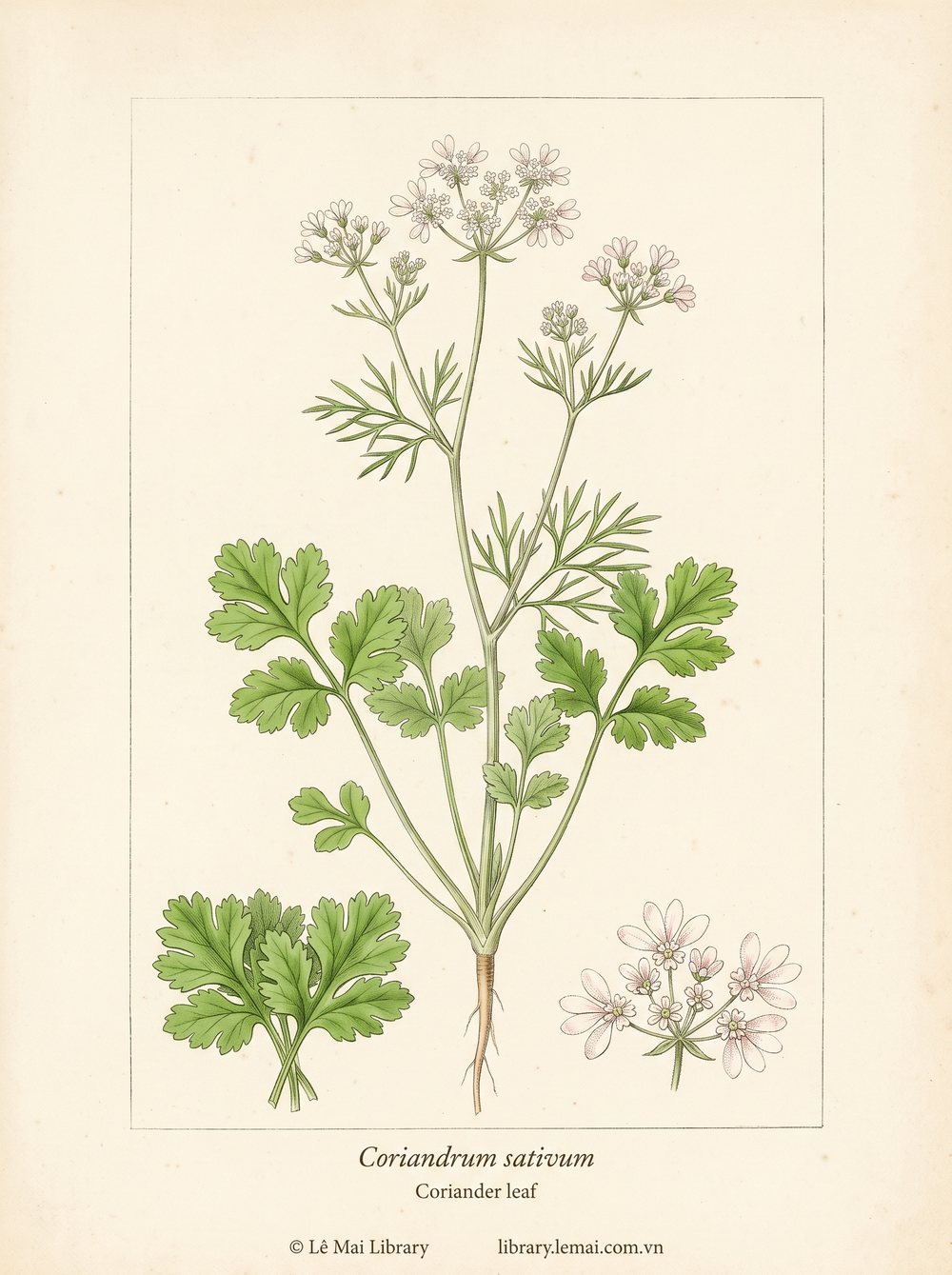
コリアンダーリーフ
Mùi, Ngò (lá)
Coriandrum sativum
Cilantro
No specific contraindications in available data.
GRAS status.
No information on dermal reactions. 2-Decenal and 2-dodecenal severely irritated rabbits when applied undiluted, but these are concentrated constituents, not the whole oil.
No information on acute toxicity for coriander leaf oil or most of its constituents. Contains no known carcinogens.
| (E)-2-Decenal | 26.8 – 46.5 % |
| Decanal | 4.4 – 18.0 % |
| Linalool | 4.3 – 17.5 % |
| Octanal | 0.5 – 11.2 % |
| (E)-2-Dodecenal | 2.7 – 10.3 % |
| 2-Decen-1-ol | < 9.2 % |
| (E)-2-Tetradecenal | tr – 5.8 % |
| (E)-2-Undecenal | 1.4 – 5.6 % |
| Decanol | 1.3 – 4.3 % |
| Nonane | 0.2 – 3.6 % |
| Tridecanal | 0.1 – 2.0 % |
| Dodecanal | 1.0 – 1.7 % |
Coriandrum sativum leaves are the fresh herb popular in Asian, Latin American and Middle Eastern cuisines, called cilantro in the US and Mexico, ngo ri in Vietnam.
The leaf oil has markedly different chemistry from the seed oil, leaves are rich in long-chain aldehydes (decenal, dodecenal), seeds are rich in linalool.
Family Apiaceae. Leaf oil production is limited, only a few producers.
Fresh cilantro evokes a 'soap-like' reaction in approximately 4 to 14 percent of the population depending on group, linked to OR6A2 gene variants.