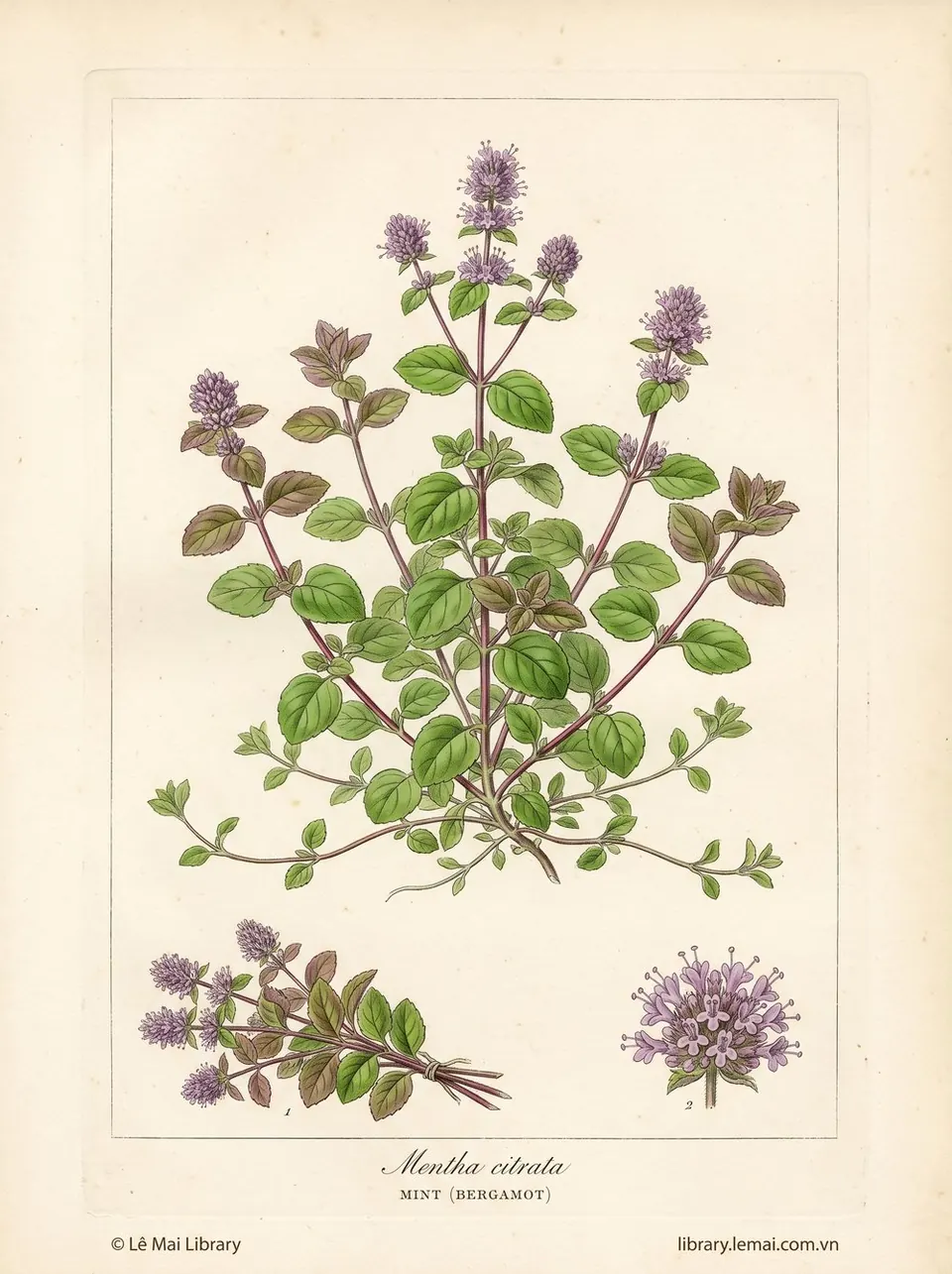
ベルガモットミント
Bạc hà cam
Mentha citrata
Bergamot mint, Eau-de-Cologne mint, Lemon mint
Bergamot mint essential oil is steam-distilled from the aerial parts of Mentha citrata, a menthol-free mint in the mint family, produced on a small scale mainly in France and North America. It smells closer to bergamot and lavender than to mint, with no cooling effect; its main components are linalool (about 30 to 45%) and linalyl acetate. It has been part of classic eau de cologne since the 18th century.
Updated 4 Nov 2026 · Lê Mai Team
Linalool and linalyl acetate dominant. Oxidation products of linalool may sensitize skin.
Aroma closer to bergamot than traditional mint, no menthol, no cooling sensation.
Store properly. No data indicates hazard in pregnancy.
| Linalool | 30.0 – 45.0 % |
| Linalyl acetate | 25.0 – 40.0 % |
| α-Terpineol | 3.0 – 8.0 % |
| (+)-Limonene | 2.0 – 5.0 % |
| 1,8-Cineole | 1.0 – 3.0 % |
Mentha citrata is a menthol-free mint cultivar. Aroma closer to bergamot and lavender than to true mint.
Traditionally used in classical 18th-century 'Eau-de-Cologne'.
Small-scale production, mainly France and parts of North America.
Family Lamiaceae.
Not a substitute for bergamot oil, similar chemistry but a completely different botanical source.
In cosmetics, used in niche fragrance and floral bouquet applications.