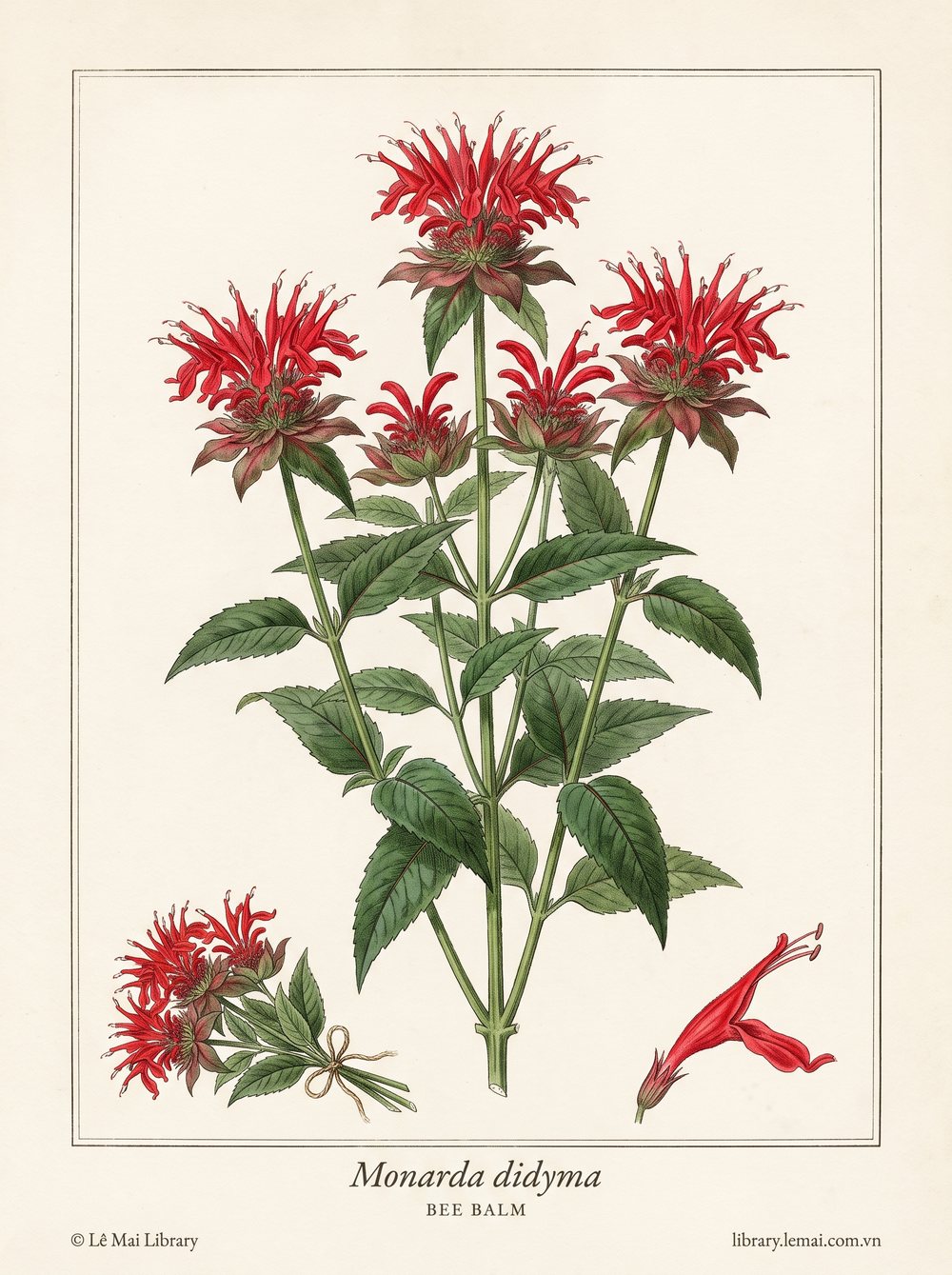
ビーバーム
Cây ong (Bee Balm, Bergamot Monarda)
Monarda didyma
Oswego tea, Scarlet monarda, Red bergamot
No specific contraindications in available data.
Approximately 83 percent of constituents are in the low-toxicity range.
Oxidation products of linalool may sensitize skin. Store in dark, sealed, refrigerated container; add an antioxidant to preparations containing bee balm.
| Linalool | 64.5 – 74.2 % |
| p-Cymene | 2.1 – 11.0 % |
| Bornyl acetate | 1.5 – 5.7 % |
| Germacrene D | 3.2 – 5.3 % |
| γ-Terpinene | 0.9 – 5.3 % |
| Sabinene | 1.4 – 5.0 % |
| 1-Octen-3-ol | 0.3 – 2.8 % |
| Camphene | 0.3 – 1.3 % |
Monarda didyma is a perennial herb with vivid red flowers, native to North America. The name 'Oswego tea' recalls the Oswego people of upstate New York who brewed the leaves as tea.
'Red bergamot' is a folk name that misleads, as the scent recalls bergamot citrus but the plant is unrelated.
The oil is steam-distilled from the flowering plant. Family Lamiaceae.