1,8-Cineole
1,3,3-Trimethyl-2-oxabicyclo[2.2.2]octane
Cineole · Eucalyptol · Cajeputol · 1,8-Epoxy-p-menthane
化学組成 · Constituent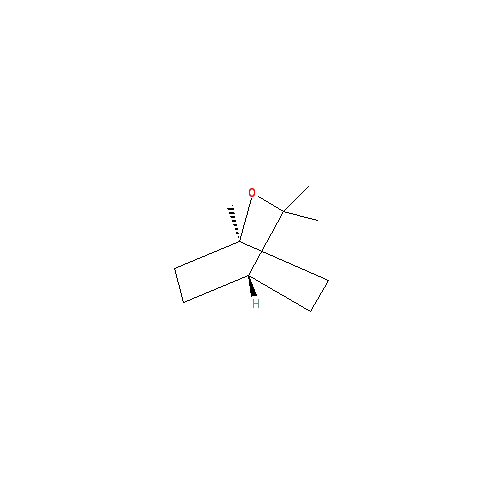
1,3,3-Trimethyl-2-oxabicyclo[2.2.2]octane
Cineole · Eucalyptol · Cajeputol · 1,8-Epoxy-p-menthane
化学組成 · Constituent
1,8-Cineole, also called eucalyptol, is one of the most important and widely distributed essential oil constituents. Present in over 200 oils. The compound is safe at practical use levels, with specific risks via inhalation in infants and young children.
Skin. A 16 percent patch test on 25 volunteers caused no irritation. Tea tree oils with 1.5–28.8 percent 1,8-cineole at 25 percent on 25 volunteers produced no irritation. A 2 percent gel on rat skin for 10 hours showed no microscopic signs of irritation.
Sensitization. Across six large studies in tea tree sensitive patients, 1,8-cineole did not cause sensitization. The compound is classified Category C, not significantly allergenic.
Oral. Acute oral LD50 in rats is 2.48 g/kg; rabbit dermal LD50 exceeds 5 g/kg. Estimated human fatal dose is 0.05–0.5 mL/kg; pediatric poisoning has been repeatedly reported.
Respiratory. Particularly dangerous when applied near infant nostrils; can cause laryngospasm. Avoid use on the face, near nose or mouth, in children under 30 months. Contraindicated in children with bronchitis or asthma.
CYP induction. 1,8-Cineole induces hepatic CYP, particularly CYP2B1 and CYP3A2. Drug interactions are theoretically possible but unlikely at typical doses.
Reproductive. Subcutaneous 500 mg/kg in pregnant rats crosses the placenta and induces fetal hepatic enzymes, but does not transfer through milk in concentrations affecting offspring.
| Eucalyptus (polybractea) | 88.7 – 91.9 % |
| Eucalyptus (globulus) | 65.4 – 83.9 % |
| Eucalyptus (camaldulensis) | 46.9 – 83.7 % |
| Eucalyptus (smithii) | 77.5 % |
| Cajuput | 41.1 – 70.8 % |
| Sage (white) | 68.4 % |
| Niaouli (cineole CT) | 55.0 – 65.0 % |
| Eucalyptus (radiata) | 60.4 – 64.5 % |
| Ho leaf (cineole CT) | 50.0 – 63.7 % |
| Cardamon (black) | 61.3 % |
| Sage (Greek) | 59.0 % |
| Marjoram (Spanish) | 45.1 – 58.6 % |
| Rosemary | 15.0 – 57.7 % |
| Saro | 46.0 – 53.0 % |
| Galangal (lesser) | 49.6 % |
| Rambiazana | 47.4 % |
| Cardamon | 26.5 – 44.6 % |
| Sanna | 44.3 % |
| Laurel leaf | 38.1 – 43.5 % |
| Sage (Spanish) | 12.0 – 40.3 % |
| Myrtle | 18.9 – 37.5 % |
| Chaste tree | 8.4 – 35.2 % |
| Niaouli (viridiflorol CT) | 30.0 – 35.0 % |
| Lavender (spike) | 28.0 – 34.9 % |
| Galangal (greater) | 30.2 – 33.6 % |
| Fragonia | 31.0 – 33.0 % |
| Eucalyptus (macarthurii) | 28.9 – 29.0 % |
| Rosalina | 18.0 – 26.0 % |
| Sage (Dalmatian) | 1.8 – 21.7 % |
| Boldo | 21.1 % |
| Tea tree | tr – 15.0 % |
| Basil (holy) | 12.6 – 16.5 % |
| Damiana | 11.4 % |
| Lavandin | 5.2 – 11.0 % |
1,8-Cineole reaches peak plasma concentration after about 18 minutes during prolonged inhalation in humans. Elimination is biphasic with a distribution half-life of 6.7 minutes and elimination half-life of 104.6 minutes.
The compound is primarily metabolized to 2-hydroxy-1,8-cineole through CYP3A4 in rats and humans, with human metabolism 2.7 times faster than rat. 1,8-Cineole is a potent skin penetration enhancer, increasing 5-fluorouracil permeation 95-fold.
1,8-Cineole is the key carrier of the expectorant and decongestant activity of eucalyptus and rosemary. The compound is widely used in adult respiratory products.
Strict warnings for children under 30 months reflect the high sensitivity of immature airways.