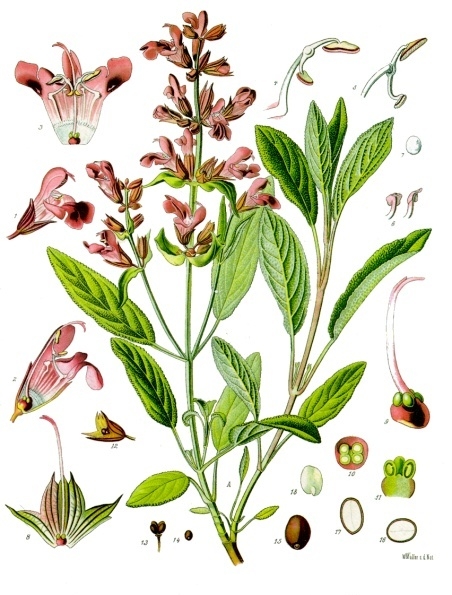
ダルマチアンセージ
Xô thơm Dalmatia
Salvia officinalis
Common sage, Garden sage
α-Thujone and β-thujone together can reach 60 percent. Both are neurotoxic, can cause seizures at high doses.
Camphor 6-25 percent also contributes to neurotoxicity.
CONTRAINDICATED in pregnancy and breastfeeding.
Contraindicated for children under 6 and individuals with a history of epilepsy.
Low skin irritation risk in adults. In 25 volunteers at 6 percent: not irritating or sensitizing.
Avoid large oral doses, historically poisoning and convulsion cases at high doses.
Verbenone CT (sometimes called 'Spanish sage') has lower thujone, safer but caution still required.
Dalmatian sage differs from Spanish sage (Salvia lavandulifolia), Spanish has much lower thujone and is safer for cosmetics.
| α-Thujone | 18.0 – 43.0 % |
| β-Thujone | 3.0 – 36.0 % |
| Camphor | 6.0 – 25.0 % |
| 1,8-Cineole | 5.5 – 13.0 % |
| Camphene | 1.5 – 7.0 % |
| α-Pinene | 1.0 – 6.5 % |
| Borneol | 1.0 – 6.0 % |
| β-Pinene | 1.0 – 5.0 % |
| α-Humulene | 0 – 4.4 % |
Salvia officinalis is a Mediterranean herb with a long history of medicinal and culinary use since antiquity. The name 'salvia' comes from Latin 'salvare', 'to heal', 'to save'.
The Dalmatia region (Croatia) produces the highest-quality oil, called 'Dalmatian sage'. Also cultivated in Albania, Bosnia, Greece, and Spain.
The essential oil is distilled from fresh or dried leaves. Thujone content varies markedly by region, harvest season, and processing.
In cuisine, Dalmatian sage is widely used, grilled meats, Thanksgiving turkey, butter-sauce pasta. Dried leaves are more common than fresh.
Family Lamiaceae (Labiatae), same family as rosemary, lavender, and thyme.
Dalmatian sage is not heavily adulterated due to moderate price, but may be mixed with clary sage (Salvia sclarea) or Spanish sage (Salvia lavandulifolia).
Chemotype verification by GC-MS is essential. The α-thujone/β-thujone ratio is the primary marker of Salvia officinalis.
Do not confuse with clary sage, clary sage contains no significant thujone and is much safer in cosmetics.
Fresh sage contains many glandular trichomes with essential oil, distillation immediately after harvest gives the best yield.
Dalmatian sage is among the most classical medicinal oils, but also one of the most dangerous if misused. A poisoning history from self-treatment is common.
Notable antibacterial and antifungal activity. In European traditional medicine, sage is used for sore throat, night sweats, and digestive issues.
In cosmetics, Dalmatian sage is used sparingly in wash-off products (deodorant, soap). Not recommended in leave-on products due to thujone.
Caution with products labeled simply 'sage essential oil', they may be Dalmatian (dangerous), Spanish (safer), Greek, or clary sage. Verify before use.
In perfumery, Dalmatian sage is often used as absolute or fractionated to remove some thujone.