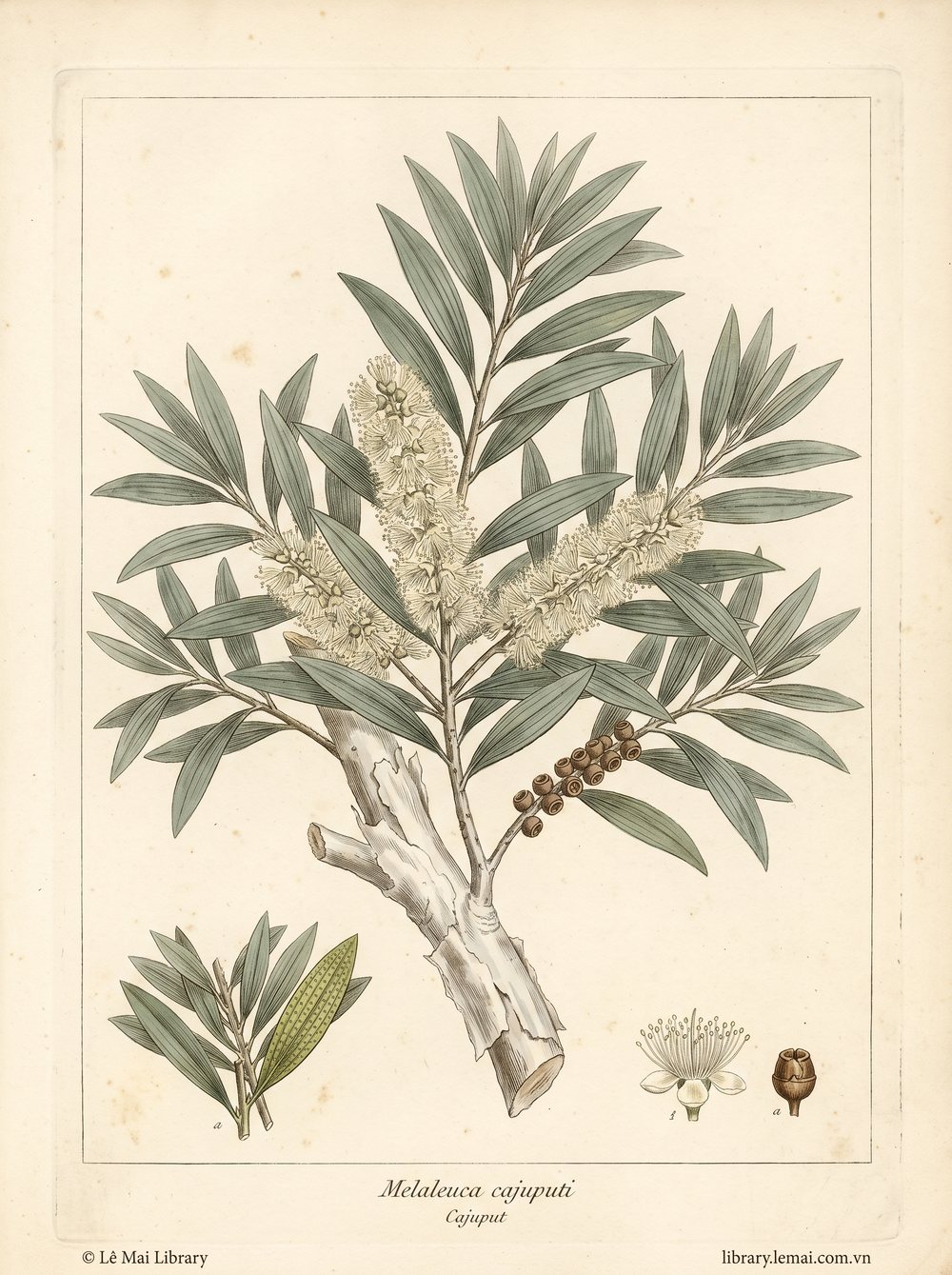
カユプテ
Tràm gió
Melaleuca cajuputi
Cajeput, River tea tree, Swamp tea tree, Weeping tea tree, Punk tree, Melaleuca leucadendron var. cajuputi
Oils high in 1,8-cineole can cause CNS and breathing problems in young children when applied near the nose.
Contraindication: do not apply to or near the face of infants or children.
Low risk of skin sensitization and irritation in adults. Non-phototoxic.
Likely not hazardous in pregnancy based on data for the major constituents.
| 1,8-Cineole | 41.1 – 70.8 % |
| α-Terpineol | 6.5 – 8.7 % |
| p-Cymene | 0.7 – 6.8 % |
| Terpinolene | 0 – 5.9 % |
| γ-Terpinene | 1.2 – 4.6 % |
| (+)-Limonene | 3.8 – 4.1 % |
| Linalool | 2.7 – 3.6 % |
| α-Pinene | 2.1 – 3.2 % |
| β-Caryophyllene | 0.7 – 2.5 % |
| β-Myrcene | 0.9 – 2.0 % |
| α-Caryophyllene | 0.5 – 1.6 % |
| β-Pinene | 0.8 – 1.5 % |
| Terpinen-4-ol | 0.6 – 1.5 % |
| Guaiol | 0 – 1.2 % |
Melaleuca cajuputi is commercially produced in Vietnam, China and Indonesia. Formerly believed to originate from Melaleuca leucadendra L.
Family Myrtaceae. Same genus as tea tree (M. alternifolia) and niaouli (M. quinquenervia).
Eucalyptus oil may be added or substituted. Oils from M. quinquenervia or M. symphyocarpa are also used to blend. Fixed oils or kerosene are occasionally used as adulterants.