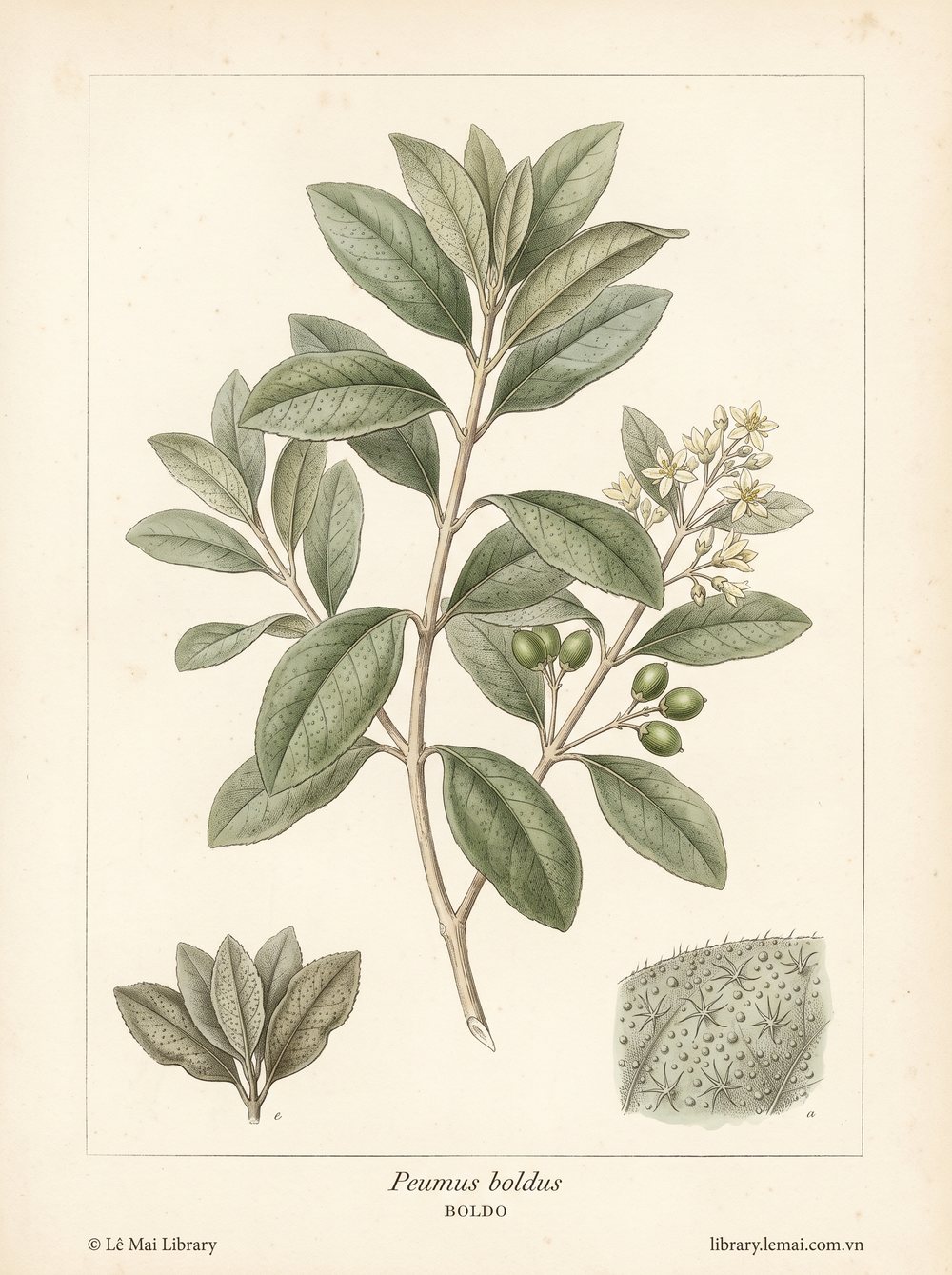
ボルド
Boldo, Lá Boldo
Peumus boldus
Boldoa fragrans
High toxicity. Neurotoxic.
Broad contraindication: should not be used, either internally or externally.
Boldo oil produced convulsions in rats at an oral dose of 70 mg per kg. Acute oral LD50 in rats 130 mg per kg.
Human data for wormseed oil (also ascaridole-rich) indicate a fatal dose in the 10 – 40 mg per kg range, suggesting ascaridole is many times more toxic to humans than to rodents.
Both α- and β-thujone are moderately toxic, with oral LD50 values from 190 to 500 mg per kg across species.
| Ascaridole | 21.3 % |
| 1,8-Cineole | 21.1 % |
| α-Thujone | 14.3 % |
| (Z)-Verbenol | 9.9 % |
| Guaiazulene | 8.8 % |
| p-Cymene | 8.6 % |
| β-Thujone | 7.2 % |
| Sabinyl acetate | 2.4 % |
Peumus boldus is a tree endemic to Chile, with dark green leathery leaves and a pungent scent. The essential oil is steam-distilled from dried leaves.
Family Monimiaceae. Boldo leaves are used traditionally in Chile as a digestive and choleretic, but the leaf form is unlike the essential oil, ascaridole and thujone are present at much lower concentrations in the leaf tea.
Chemotypes of Peumus boldus with very low ascaridole exist but are not commercially available.
On a risk/benefit basis, there is no rationale for using boldo essential oil. The risk is too high relative to any aesthetic or therapeutic value it might offer.