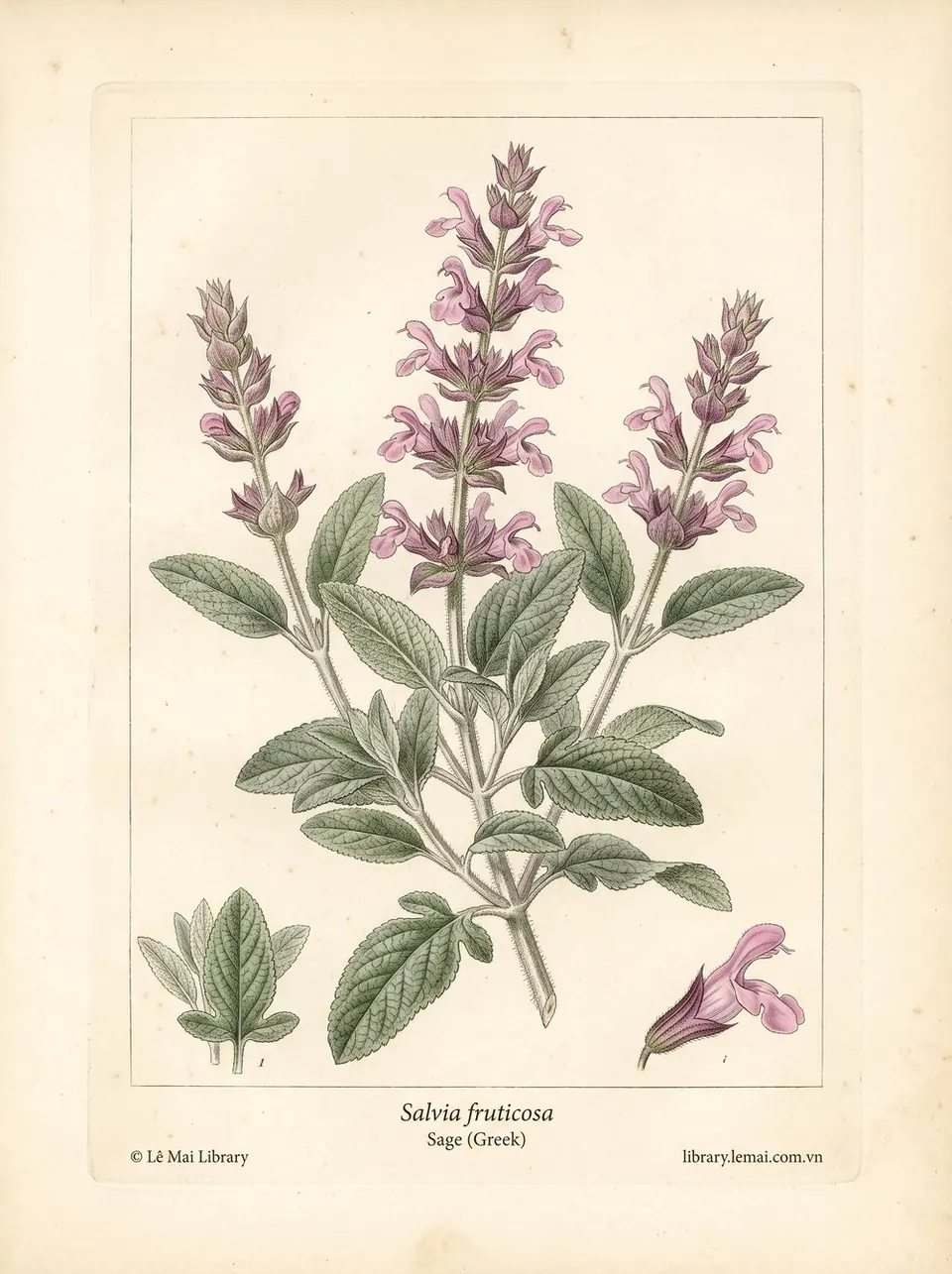
グリークセージ
Xô thơm Hy Lạp
Salvia fruticosa
Salvia triloba
Greek sage essential oil is steam-distilled from the leaves of Salvia fruticosa, a small mint-family shrub from Greece, Cyprus, Turkey and North Africa; in Greece the leaves are brewed as faskomilo tea. Its main component is 1,8-cineole (about 50 to 65%), and it has much less thujone than Dalmatian sage. Because it is rich in cineole, do not apply it near the face of children under 6.
Updated 4 Nov 2026 · Lê Mai Team
1,8-Cineole 50-65 percent. DO NOT apply near the face of children under 6.
Thujone much lower than Dalmatian sage, safer neurologically.
Low skin sensitization risk.
| 1,8-Cineole | 50.0 – 65.0 % |
| Camphor | 5.0 – 12.0 % |
| α-Pinene | 3.0 – 8.0 % |
| Camphene | 2.0 – 6.0 % |
| β-Pinene | 2.0 – 5.0 % |
| α-Thujone | 0.5 – 5.0 % |
Salvia fruticosa grows in Greece, Cyprus, Turkey, and North Africa. A small shrub.
Family Lamiaceae.
Traditionally brewed as 'faskomilo' tea in Greece. Limited oil production.