Diallyl disulfide
Di-(2-propenyl) disulfide
Allyl disulfide · Garlicin · 4,5-Dithia-1,7-octadiene
化学組成 · Constituent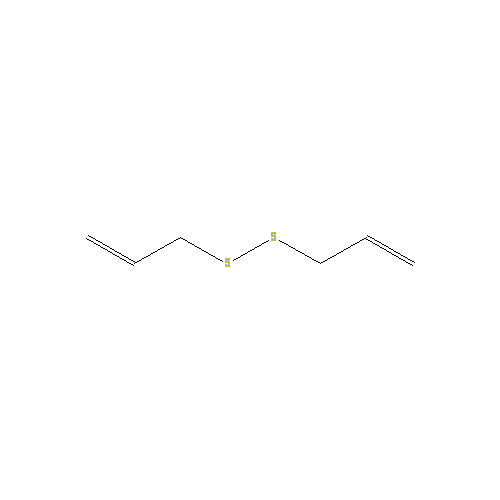
Di-(2-propenyl) disulfide
Allyl disulfide · Garlicin · 4,5-Dithia-1,7-octadiene
化学組成 · Constituent
Diallyl disulfide là cấu tử chính trong tinh dầu tỏi. Hợp chất có hoạt tính sinh học mạnh, vừa độc tế bào vừa bảo vệ gan tuỳ liều.
Trên da. Bôi nguyên chất trên da thỏ gây kích ứng. Patch test ở 1 phần trăm trên 31 tình nguyện viên không gây mẫn cảm. Ở người dị ứng với tỏi, patch test 5 phần trăm cho phản ứng ở 18 trong 23 trường hợp, nhưng không phản ứng ở mức 0.5 phần trăm. Có ghi nhận viêm da tiếp xúc do photoallergy và toàn thân.
Đường uống. LD50 cấp tính qua đường uống trên chuột nhắt 145 mg/kg (đực) và 130 mg/kg (cái), trên chuột 260 mg/kg. LD50 qua da trên thỏ 3.6 g/kg.
Mạch máu. Diallyl disulfide ức chế kết tập tiểu cầu mạnh in vitro.
Gan. Gây độc tế bào gan ở 2 mM, nhưng ở liều thấp 14.6 mg/kg đường uống lại bảo vệ gan chuột khỏi tổn thương do carbon tetrachloride.
Đột biến gen và ung thư. Có hoạt tính lưỡng tính, vừa gây vừa chống đột biến tuỳ ngữ cảnh. Cảm ứng các enzyme giải độc giai đoạn II, gây apoptosis ở tế bào ung thư đại trực tràng, gan, máu, ngực và da.
Diallyl disulfide is the principal constituent of garlic oil. The compound is biologically active, being both cytotoxic and hepatoprotective depending on dose.
Skin. Applied undiluted to rabbit skin it was irritating. A 1 percent patch test on 31 volunteers was not sensitizing. In garlic-sensitive individuals a 5 percent patch test produced reactions in 18 of 23 cases, but none at 0.5 percent. Photoallergic and systemic contact dermatitis have been reported.
Oral. Acute oral LD50 in mice is 145 mg/kg (male) and 130 mg/kg (female), in rats 260 mg/kg. Acute dermal LD50 in rabbits is 3.6 g/kg.
Cardiovascular. Diallyl disulfide shows strong antiplatelet aggregation activity in vitro.
Liver. Cytotoxic to hepatocytes at 2 mM, but at the low dose of 14.6 mg/kg orally it protected rat liver from carbon tetrachloride damage.
Mutagenicity and cancer. The compound shows dual activity, both inducing and protecting against mutagenesis depending on context. It induces phase II detoxifying enzymes, triggers apoptosis in colorectal, liver, blood, breast and skin cancer cells.
| Tỏi · Garlic | 25.2 – 46.8 % |
| Mù tạt · Mustard | 0 – 4.1 % |
Sau khi tiêm phúc mạc trên chuột nhắt, hơn 80 phần trăm hợp chất tập trung trong cytosol gan sau hai giờ. Diallyl disulfide được chuyển hoá chính thành allyl mercaptan và allyl methyl sulfide trong tế bào gan chuột, và bị khử thành diallyl sulfide trong gan thỏ tưới máu.
Hợp chất cảm ứng các enzyme giải độc giai đoạn II như glutathione S-transferase và glutathione peroxidase, đây là cơ chế chính giải thích cả hoạt tính bảo vệ gan và chống ung thư của nó.
After ip injection in mice, more than 80 percent of the compound concentrates in liver cytosol within two hours. Diallyl disulfide is primarily metabolized to allyl mercaptan and allyl methyl sulfide in rat hepatocytes, and is reduced to diallyl sulfide in the isolated perfused rat liver.
The compound induces phase II detoxifying enzymes such as glutathione S-transferase and glutathione peroxidase, which is the principal mechanism explaining both its hepatoprotective and anticancer activities.
Diallyl disulfide cùng với diallyl trisulfide tạo nên hương và hoạt tính sinh học đặc trưng của tỏi. Trong nước hoa và mỹ phẩm, các tinh dầu chứa sulfide như tỏi, mù tạt, hành rất hiếm khi được dùng vì mùi quá nồng và rủi ro kích ứng.
Diallyl disulfide together with diallyl trisulfide accounts for the characteristic aroma and bioactivity of garlic. Sulfide-rich essential oils such as garlic, mustard and onion are rarely used in perfumery or cosmetics due to overpowering odor and irritation risk.