Cinnamaldehyde
3-Phenyl-2-propenal
Cinnamal · Cinnamic aldehyde · β-Phenylacrolein
化学組成 · Constituent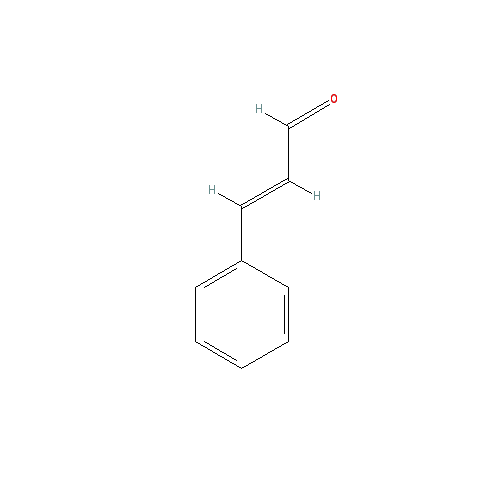
3-Phenyl-2-propenal
Cinnamal · Cinnamic aldehyde · β-Phenylacrolein
化学組成 · Constituent
Cinnamaldehyde là cấu tử chính của cinnamon bark, cassia bark và cassia leaf. Hợp chất là chất gây mẫn cảm da và kích ứng đáng kể, được xếp là chất gây dị ứng vừa.
Trên da. Patch test 48 giờ ở 3 phần trăm không kích ứng, ở 8 phần trăm gây kích ứng nghiêm trọng. Maximation test ở 0.5 phần trăm gây 8 phần trăm mẫn cảm, ở 2 phần trăm 44 phần trăm, ở 8 phần trăm 32 phần trăm. Cinnamaldehyde gây phản ứng tức thì kiểu mề đay (NIICR) phụ thuộc nồng độ.
Trong nhiều nghiên cứu trên 25.000 bệnh nhân viêm da châu Âu, tỷ lệ mẫn cảm với 1–5 phần trăm cinnamaldehyde giảm dần từ 1980 đến 1996 do giảm nồng độ trong sản phẩm chăm sóc cá nhân.
Đường uống. LD50 cấp tính chuột 2.2 g/kg; LD50 da thỏ vượt 5 g/kg.
Bán mãn tính. NOAEL chuột 90 ngày là 215 mg/kg/ngày qua gavage. Liều 1.075 mg/kg/ngày trong 90 ngày gây tổn thương dạ dày trước và tăng tử vong.
Sinh sản. Liều gavage 5–250 mg/kg/ngày trên chuột mang thai ngày 6–15 cho NOAEL của mẹ 50 mg/kg/ngày và NOAEL phát triển 250 mg/kg/ngày.
Tim mạch. Hoạt tính chống kết tập tiểu cầu, có thể tương tác với thuốc chống đông.
Đột biến gen. Cinnamaldehyde không gây đột biến trong Ames test với S9, có hoạt tính chống đột biến rộng. Hợp chất là chất tạo ra sự thích ứng (adaptive response) chứ không phải genotoxic thực sự.
Khuyến nghị nồng độ tối đa 0.05 phần trăm trên da cho mẫn cảm. IFRA giới hạn 0.05 phần trăm trong leave-on.
Cinnamaldehyde is the major constituent of cinnamon bark, cassia bark and cassia leaf. The compound is a significant skin sensitizer and irritant, classified as a moderate fragrance allergen.
Skin. A 48-hour patch test at 3 percent caused no irritation; at 8 percent it was severely irritating. Maximation testing at 0.5 percent gave 8 percent sensitization, at 2 percent 44 percent, at 8 percent 32 percent. Cinnamaldehyde elicits concentration-dependent non-immune immediate contact reactions (urticaria).
Across studies in over 25,000 European dermatitis patients, the rate of reactivity to 1–5 percent cinnamaldehyde declined from 1980 to 1996 as concentrations in personal care products fell.
Oral. Acute oral LD50 in rats is 2.2 g/kg; rabbit dermal LD50 exceeds 5 g/kg.
Subchronic. Rat 90-day NOAEL is 215 mg/kg/day by gavage. At 1,075 mg/kg/day for 90 days, forestomach damage and increased mortality occurred.
Reproductive. Gavage 5–250 mg/kg/day in pregnant rats on days 6–15 gave maternal NOAEL of 50 mg/kg/day and developmental NOAEL of 250 mg/kg/day.
Cardiovascular. Antiplatelet aggregation activity, with potential anticoagulant drug interaction.
Mutagenicity. Non-mutagenic in the Ames test with S9; broadly antimutagenic. The compound elicits an adaptive response rather than true genotoxicity.
Recommended dermal maximum is 0.05 percent for sensitization. IFRA limits 0.05 percent in leave-on products.
| Quế Cassia · Cassia | 54.6 – 90.1 % |
| Quế (vỏ) · Cinnamon bark | 63.1 – 75.7 % |
| Bakul (Mimusops elengi) · Bakul | 1.3 % |
| Quế (lá) · Cinnamon leaf | 0.6 – 1.1 % |
Cinnamaldehyde phân phối 75–85 phần trăm vào đường tiêu hoá sau khi uống ở chuột. Đường chuyển hoá chính là phân huỷ thành benzoic acid qua beta-oxidation và bài tiết qua nước tiểu dưới dạng hippuric acid (82–85 phần trăm).
Liều cao 500 mg/kg ở chuột chuyển dòng chuyển hoá khác hẳn so với liều thấp, chỉ 7.6 phần trăm hippuric acid và 73.3 phần trăm benzoic acid.
Cinnamaldehyde chuyển hoá thành cinnamic alcohol và cinnamic acid trong da người. Sau bôi 10 μL trên da phụ nữ cắt bỏ với occlusion 24 giờ, 9.4 phần trăm hấp thu.
Cinnamaldehyde distributes 75–85 percent to the GI tract after oral dosing in rats. The major metabolic pathway is degradation to benzoic acid via beta-oxidation and urinary excretion as hippuric acid (82–85 percent).
High doses of 500 mg/kg in rats shift the metabolic profile significantly compared to lower doses, with only 7.6 percent hippuric acid and 73.3 percent benzoic acid.
Cinnamaldehyde is metabolized to cinnamic alcohol and cinnamic acid in human skin. After 10 μL applied to excised female skin under 24-hour occlusion, 9.4 percent was absorbed.
Cinnamaldehyde là cấu tử quyết định mùi quế cổ điển. Hợp chất có hoạt tính kháng khuẩn mạnh và là chất bảo quản tự nhiên.
Trên 25 năm dữ liệu lâm sàng cho thấy giảm nồng độ trong sản phẩm chăm sóc cá nhân là chiến lược hiệu quả để giảm tỷ lệ mẫn cảm trong dân số.
Cinnamaldehyde defines the classical cinnamon aroma. The compound has strong antibacterial activity and serves as a natural preservative.
Over 25 years of clinical data show that reducing concentrations in personal care products effectively reduces population sensitization rates.