Bornyl acetate
endo-1,7,7-Trimethylbicyclo[2.2.1]hept-2-yl ethanoate
endo-Borneol acetate · Acetic acid bornyl ester
化学組成 · Constituent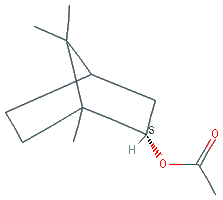
endo-1,7,7-Trimethylbicyclo[2.2.1]hept-2-yl ethanoate
endo-Borneol acetate · Acetic acid bornyl ester
化学組成 · Constituent
Bornyl acetate is a monoterpene ester common in pine and fir oils. The compound presents very low toxicity risk.
Skin. A 2 percent patch test on human subjects gave no irritation or sensitization.
Oral. Acute oral LD50 in rats exceeds 5 g/kg, rabbit dermal LD50 exceeds 10 mL/kg, both indicating very low toxicity.
Data are sparse but the ester structure does not raise specific safety flags.
| Inula | 46.1 % |
| Spruce (black) | 36.8 % |
| Valerian (European) | 0.9 – 33.5 % |
| Fir needle (Siberian) | 31.0 % |
| Fir needle (Japanese) | 27.9 % |
| Goldenrod | 19.5 % |
| Spruce (red) | 16.4 % |
| Fir needle (Canadian) | 4.9 – 16.2 % |
| Coleus | 15.0 % |
| Rosemary | 11.5 – 14.3 % |
| Spruce (white) | 14.1 % |
| Pine (grey) | 12.5 – 12.6 % |
| Fir cones (silver) | 1.3 – 12.5 % |
| Fir (Douglas) | 10.0 % |
| Larch needle | 7.9 % |
| Pine (dwarf) | 1.0 – 7.9 % |
| Tansy | 7.7 % |
| Hinoki leaf | 7.2 % |
| Bee balm | 1.5 – 5.7 % |
| Sage (Dalmatian) | 0.3 – 5.7 % |
| Spruce (Norway) | 3.0 – 5.1 % |
Bornyl acetate is the principal carrier of coniferous forest notes in pine and fir oils. The compound is the isomer of isobornyl acetate.