Camphor
1,7,7-Trimethylbicyclo[2.2.1]heptan-2-one
2-Bornanone · 2-Camphanone
化学組成 · Constituent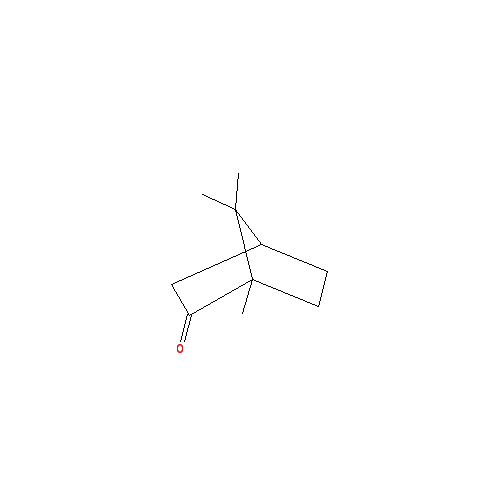
1,7,7-Trimethylbicyclo[2.2.1]heptan-2-one
2-Bornanone · 2-Camphanone
化学組成 · Constituent
Camphor is among the most extensively studied essential oil constituents and has a significant history of clinical poisoning. Estimated human lethal dose is 5–20 grams (50–550 mg/kg) in adults; in children just 700–1,000 mg can be fatal, and in infants 70 mg/kg.
Skin. Camphor can irritate when applied excessively or too vigorously. Two patients developed acute eczema from a camphor-containing spray, although a 10 percent patch test on them did not react.
Mucous membranes and eyes. Camphor is an eye and mucous membrane irritant, capable of causing burning pain in the mouth and throat.
Oral. Acute oral LD50 in mice is 1.31 g/kg, in rats exceeds 5 g/kg; rabbit dermal LD50 exceeds 5 g/kg. Intraperitoneal fatal dose in cats is 400 mg/kg.
Respiratory. Camphor-containing preparations should not be placed near infant nostrils as they may cause respiratory collapse. Inhalation LD50 in mice is 450 mg/m3.
Children. A 2 g dose usually causes toxic effects, 4 g can be fatal. In children, 700–1,000 mg has been reported fatal; 70 mg/kg in infants can be fatal.
Neurological. Poisoning follows a pattern of CNS stimulation (delirium, seizures) followed by depression (incoordination, respiratory depression, coma). Onset is within 5–15 minutes after ingestion.
Reproductive. Camphor crosses the placenta freely and is porphyrigenic. Pregnant women should avoid it.
Storage and use. Children under six, and patients with epilepsy, asthma or G6PD deficiency, should avoid camphor-containing products.
| Ho leaf (camphor CT) | 42.0 – 84.1 % |
| Lavender (Spanish) | 16.4 – 56.2 % |
| Wormwood (white) | 34.0 – 55.0 % |
| Sage (Dalmatian) | 7.3 – 50.2 % |
| Feverfew | 28.0 – 44.2 % |
| Sage (Spanish) | 12.9 – 36.1 % |
| Basil (Madagascan) | 24.0 – 30.0 % |
| Rosemary | 2.0 – 27.3 % |
| Lavender (spike) | 10.8 – 23.2 % |
| Finger root | 16.9 % |
| Fenugreek | 16.3 % |
| Galangal (greater) | 5.0 – 14.0 % |
| Yarrow (green) | 13.7 % |
| Tansy (blue) | 3.1 – 12.4 % |
| Lavandin | 6.6 – 12.2 % |
| Mango ginger | 11.2 % |
| Marjoram (Spanish) | 5.5 – 8.9 % |
| Zedoary | 1.7 – 7.8 % |
| Coriander seed | 1.6 – 7.7 % |
| Sassafras | 1.2 – 6.8 % |
| Camphor (Borneo) | 8.3 % |
| Camphor (white) | 2.4 % |
| Camphor (brown) | < 3.0 % |
| Tansy | 3.2 % |
| Thuja | 2.2 – 2.5 % |
Camphor is metabolized by hydroxylation at the 3-, 5-, 8- and 9- positions, then oxidized to corresponding ketones and carbonic acids. The compound can be reduced to borneol in dog and rabbit liver. Distinct species differences exist.
Camphor is rapidly absorbed across mucous membranes and crosses the placenta. The primary human metabolite is 5-exo-hydroxycamphor via CYP2A6. Camphor is porphyrigenic, posing a risk to those with hepatic heme synthesis defects.
Camphor is produced naturally from Cinnamomum camphora and Dryobalanops aromatica, or industrially from α-pinene. The compound appears in hundreds of essential oils at low levels.
Camphor-containing products have caused thousands of pediatric poisonings, particularly through accidental ingestion of camphorated oil. Death results from respiratory depression or complications of status epilepticus.