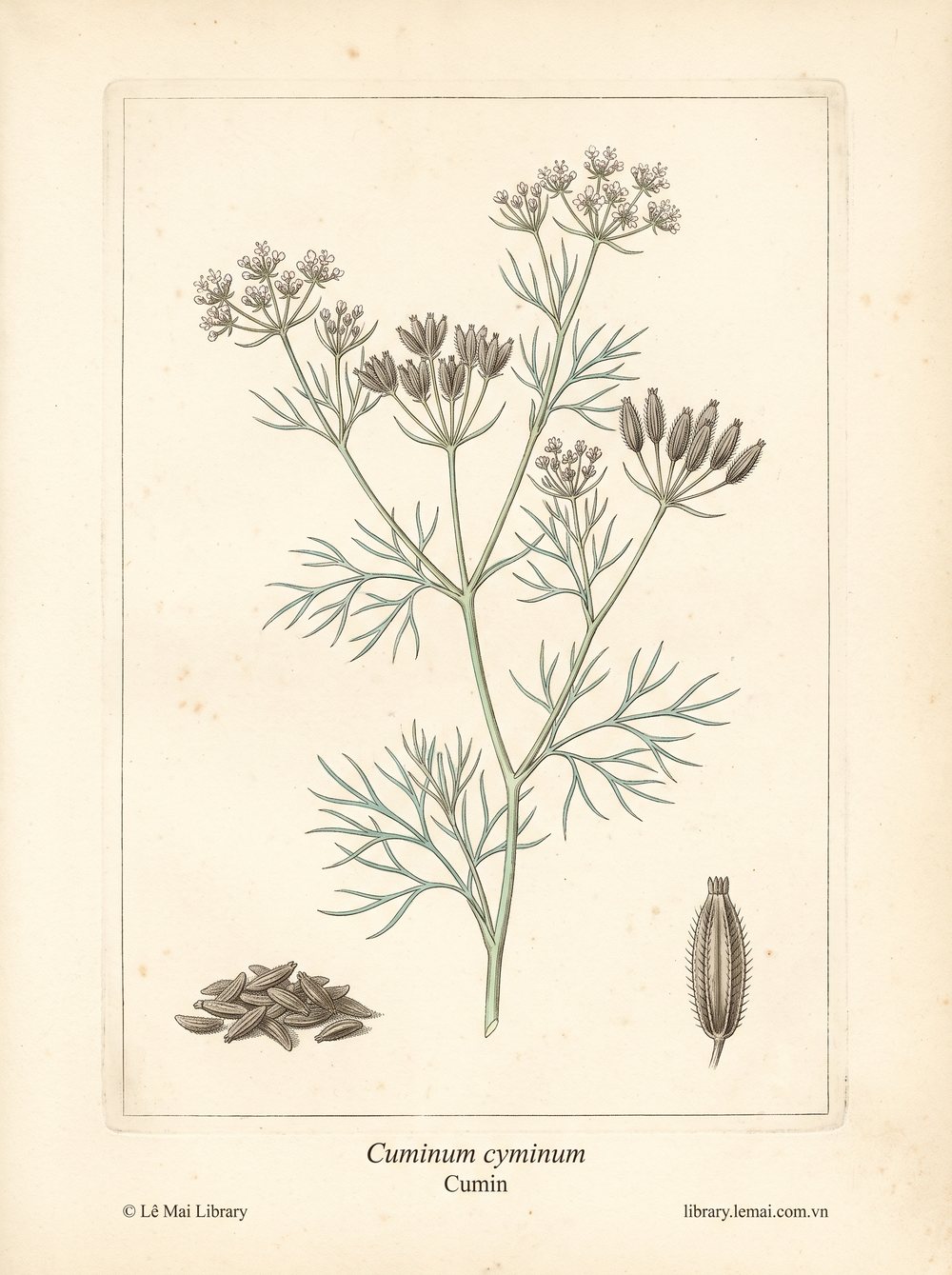
クミン
Thì là Ai Cập
Cuminum cyminum
Moderately phototoxic.
Dermal contraindication: if applied above maximum use level, skin must not be exposed to sunlight or UV for 12 hours.
Maximum dermal use level 0.4 percent.
GRAS status.
Cumin oil increased glutathione S-transferase activity in the stomach, liver and esophagus of mice by over 78 percent, significantly inhibiting B[a]P-induced squamous cell stomach carcinoma.
| Cuminaldehyde | 19.8 – 40.0 % |
| γ-Terpinene | 11.2 – 32.0 % |
| β-Pinene | 4.4 – 17.7 % |
| p-Cymene | 5.9 – 17.5 % |
| p-Mentha-1,3-dien-7-al | 3.2 – 7.2 % |
| p-Mentha-1,4-dien-7-al | 2.1 – 8.6 % |
| β-Myrcene + α-Phellandrene | 0.5 – 7.3 % |
| p-Menth-3-en-7-al | 0.5 – 2.5 % |
| Cuminyl alcohol | 0.2 – 2.2 % |
| α-Pinene | 0.2 – 1.2 % |
Cuminum cyminum is an annual herb of the eastern Mediterranean. Cumin seed is an essential spice in Middle Eastern, Indian and Mexican cuisines.
The oil is steam-distilled from the seeds. Produced in Egypt, Iran, India, Syria.
Family Apiaceae. Cumin oil is phototoxic, unusual for a seed oil; the risk must be noted.
May be adulterated with synthetic cuminaldehyde.