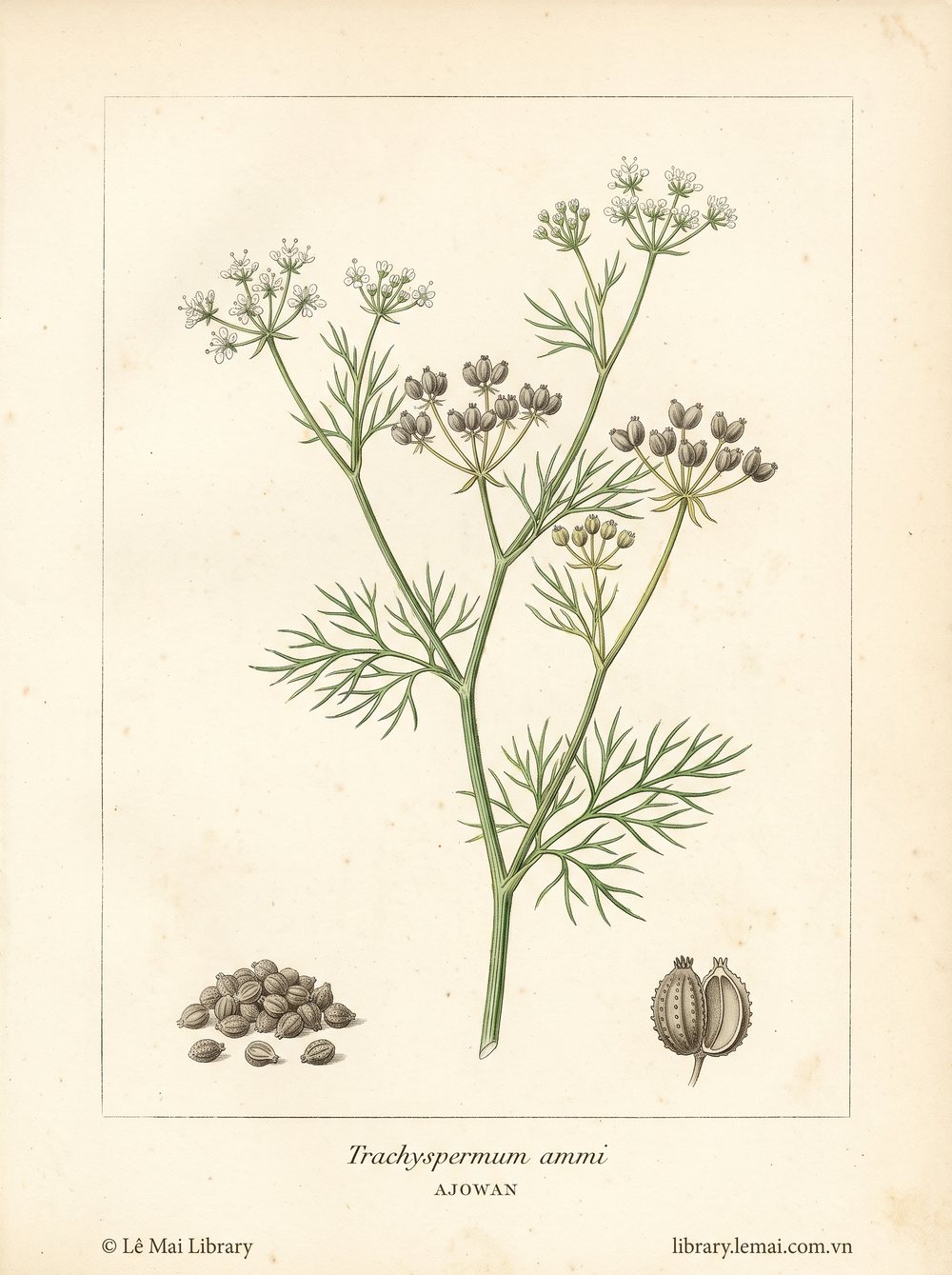
アジョワン
Ajowan, Hương nhu Ấn, Caraway Ấn
Trachyspermum ammi
Ajwain, Bishop's weed, Sprague
Drug interactions. May inhibit blood clotting due to high thymol and carvacrol content.
Low skin irritation risk. Moderate mucous membrane irritation.
Oral: avoid with anticoagulant medication, before major surgery, peptic ulcer, hemophilia.
Thymol and carvacrol inhibit platelet aggregation — an essential step in the blood clotting cascade.
| Thymol | 36.9 – 53.8 % |
| γ-Terpinene | 14.6 – 35.0 % |
| p-Cymene | 20.8 – 24.0 % |
| Carvacrol | 1.0 – 16.4 % |
| Limonene | 0.25 – 5.1 % |
| β-Pinene | 1.2 – 3.5 % |
| α-Pinene | 0.3 – 1.8 % |
Trachyspermum ammi belongs to the Apiaceae family, related to celery, parsley, carrot.
Seeds are widely used as spice in Indian cuisine. The essential oil is extracted by steam distillation.
Mainly produced in India. Rarely found outside India, the Seychelles and the West Indies.
A thymol-free variant of ajowan oil exists — containing 46% carvone and 38% limonene.
Due to high phenolic content, ajowan belongs to the higher-irritation-risk group. Dilute thoroughly before skin contact.