(-)-Limonene
(S)-(-)-1-Methyl-4-(1-methylethenyl)cyclohexene
(S)-(-)-Limonene · l-Limonene · p-Mentha-1,8-diene · 1,8-p-Menthadiene
化学組成 · Constituent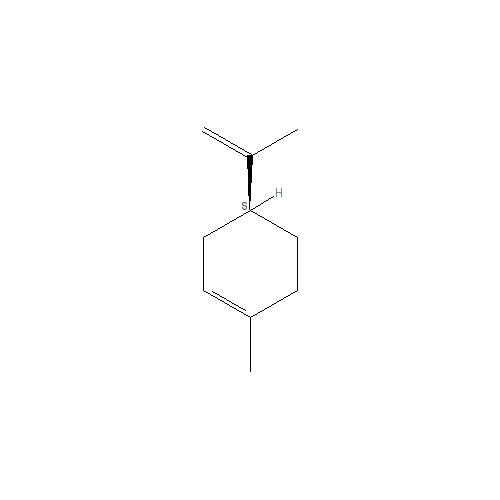
(S)-(-)-1-Methyl-4-(1-methylethenyl)cyclohexene
(S)-(-)-Limonene · l-Limonene · p-Mentha-1,8-diene · 1,8-p-Menthadiene
化学組成 · Constituent
(-)-Limonene là đồng phân quang học của (+)-limonene, xuất hiện như cấu tử phụ trong một số tinh dầu thông, bạc hà và các loại khác.
Trên da. Thử nghiệm patch ở 4 phần trăm trên 25 người tình nguyện không gây kích ứng và không gây mẫn cảm. Trên 1.200 bệnh nhân viêm da, 2 phần trăm (-)-limonene không gây phản ứng kích ứng hay dị ứng. Tuy nhiên, (-)-limonene đã oxi hoá ở 3 phần trăm gây phản ứng dị ứng ở 6 trên 658 bệnh nhân chàm tay (0.9 phần trăm).
Độc tính cấp. LD50 cấp tính trên chuột qua đường uống vượt 5 g/kg. LD50 cấp tính qua da trên thỏ vượt 5 g/kg.
Thận. (-)-Limonene gây bệnh thận giọt protein ở chuột đực khi cho ăn 800 hoặc 1.600 mg/kg/ngày trong 28 ngày. Cũng giống (+)-limonene, hiệu ứng này đặc thù cho chuột đực do mức a2u-globulin cao và không liên quan đến con người.
(-)-Limonene is the optical enantiomer of (+)-limonene, appearing as a minor constituent in some pine, mint and other oils.
Skin. A 4 percent patch test on 25 volunteers showed no irritation or sensitization. On 1,200 dermatitis patients, 2 percent (-)-limonene caused no irritant or allergic reactions. However, oxidized (-)-limonene at 3 percent caused allergic reactions in 6 of 658 hand eczema patients (0.9 percent).
Acute toxicity. Acute oral LD50 in rats exceeded 5 g/kg. Acute dermal LD50 in rabbits exceeded 5 g/kg.
Kidney. (-)-Limonene caused protein droplet nephropathy in male rats when given by gavage at 800 or 1,600 mg/kg/day for 28 days. As with (+)-limonene, this effect is specific to male rats due to high a2u-globulin levels and is not relevant to humans.
(-)-Limonene tinh khiết không phản ứng da, nhưng dạng oxi hoá có thể gây dị ứng. Hợp chất xuất hiện như cấu tử phụ trong một vài tinh dầu thông và bạc hà.
Pure (-)-limonene is not skin reactive, but the oxidized form can be allergenic. The compound appears as a minor constituent in some pine and mint oils.