(-)-Limonene
(S)-(-)-1-Methyl-4-(1-methylethenyl)cyclohexene
(S)-(-)-Limonene · l-Limonene · p-Mentha-1,8-diene · 1,8-p-Menthadiene
化学組成 · Constituent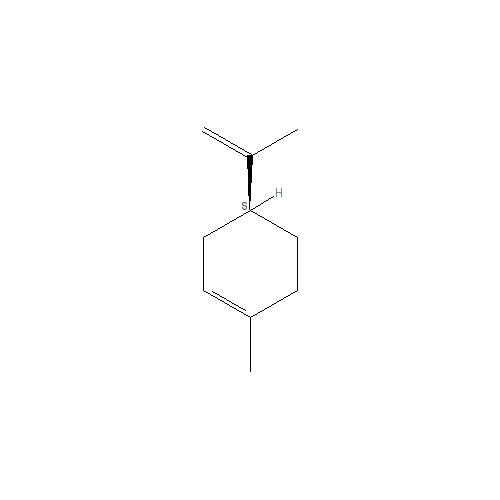
(S)-(-)-1-Methyl-4-(1-methylethenyl)cyclohexene
(S)-(-)-Limonene · l-Limonene · p-Mentha-1,8-diene · 1,8-p-Menthadiene
化学組成 · Constituent
(-)-Limonene is the optical enantiomer of (+)-limonene, appearing as a minor constituent in some pine, mint and other oils.
Skin. A 4 percent patch test on 25 volunteers showed no irritation or sensitization. On 1,200 dermatitis patients, 2 percent (-)-limonene caused no irritant or allergic reactions. However, oxidized (-)-limonene at 3 percent caused allergic reactions in 6 of 658 hand eczema patients (0.9 percent).
Acute toxicity. Acute oral LD50 in rats exceeded 5 g/kg. Acute dermal LD50 in rabbits exceeded 5 g/kg.
Kidney. (-)-Limonene caused protein droplet nephropathy in male rats when given by gavage at 800 or 1,600 mg/kg/day for 28 days. As with (+)-limonene, this effect is specific to male rats due to high a2u-globulin levels and is not relevant to humans.
Pure (-)-limonene is not skin reactive, but the oxidized form can be allergenic. The compound appears as a minor constituent in some pine and mint oils.