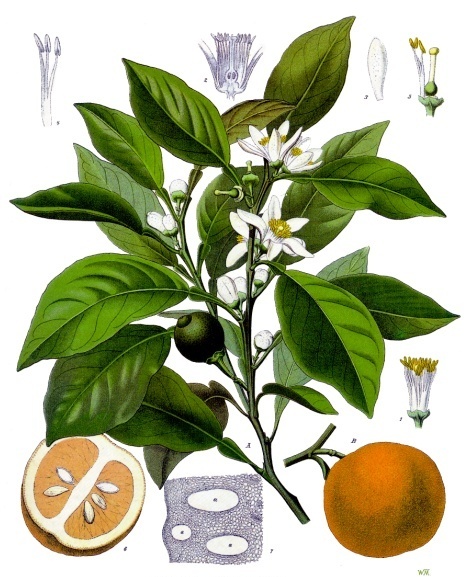
オレンジフラワー
Hoa cam
Citrus x aurantium
Orange blossom absolute
May contain benzyl cyanide up to 1 percent. IFRA restricts benzyl cyanide to 0.01 percent in the finished product.
Mild skin sensitization risk. Reports indicate orange flower absolute is 'weakly phototoxic' in 14 volunteers.
Linalool 30-32 percent, oxidation products may sensitize skin. Store properly.
No data indicates hazard in pregnancy, 2-phenylethanol and linalool have low reproductive toxicity.
| 2-Phenylethanol | 4.5 – 35.0 % |
| Linalool | 30.0 – 32.0 % |
| Linalyl acetate | 7.0 – 16.8 % |
| Methyl anthranilate | 3.0 – 15.0 % |
| Farnesol | tr – 7.7 % |
| Nerolidol | 0 – 7.6 % |
| (+)-Limonene + (Z)-β-ocimene | 0 – 5.1 % |
| Nerol | 0.9 – 4.0 % |
| Neryl acetate | 0.8 – 4.0 % |
| α-Terpineol | 2.0 – 2.4 % |
| Geraniol | < 1.5 % |
| Benzyl cyanide | 1.0 % |
| Indole | 0.1 – 1.0 % |
Orange flower absolute is a solvent-extracted product from bitter orange blossoms (Citrus x aurantium). Same raw material as neroli (steam-distilled) but different method and aromatic profile.
The absolute has a richer aroma, closer to fresh flowers than neroli. In perfumery, the absolute is often used alongside neroli to create depth.
Main production: France, Tunisia, Morocco.
Family Rutaceae.
Indole content (0.1-1%) gives a characteristic 'animalic' note, absent in distilled neroli. This is a marker of true absolute, not perfectly replicable by synthesis.
In modern perfumery, orange flower absolute is a premium ingredient for niche fine fragrance.