Indole
Benzo[b]pyrrole
1H-Indole · 2,3-Benzopyrrole
化学組成 · Constituent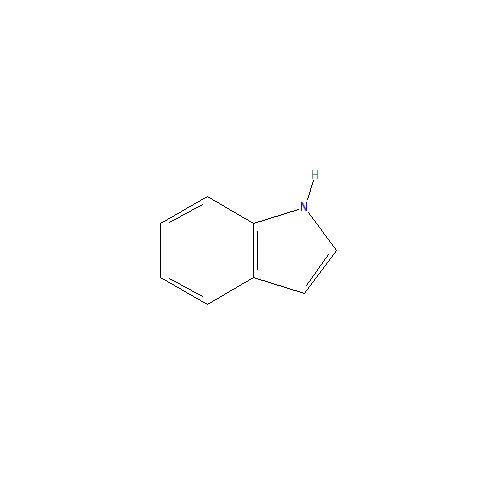
Benzo[b]pyrrole
1H-Indole · 2,3-Benzopyrrole
化学組成 · Constituent
Indole is a heterocyclic nitrogen with a central role in the aroma of jasmine and orange-blossom. The compound has moderate toxicity.
Skin. A 1 percent patch test on 25 volunteers produced no sensitization. Undiluted material was not irritating to rabbit skin.
Oral and dermal. Acute oral LD50 in rats is 1 mL/kg. Single skin-penetration LD50 in rabbits is 0.79 mL/kg. This 'moderate' level is not concerning given the very low concentrations in essential oils.
Mutagenicity. Not mutagenic in the Ames test.
| Jasmine sambac | 14.1 % |
| Champaca (orange) | 2.9 – 12.0 % |
| Ginger lily | 7.0 % |
| Jasmine | 0.7 – 3.5 % |
| Honeysuckle | 3.3 % |
| Jonquil | 1.7 % |
| Narcissus | 0 – 1.5 % |
| Orange flower | 0.1 – 1.0 % |
In rats, indole is metabolized by hydroxylation and excreted partly as glucuronide but mainly as the sulfate conjugate. After oral dosing, 80 percent is excreted in urine, 10 percent in feces and 2 percent in expired air. The major urinary metabolite is indoxyl sulfate.
Indole is the constituent responsible for the 'dark side' of white-flower oils. At high concentration its odor is unpleasant, but at extreme dilution it becomes indispensable to the jasmine and orange-blossom profile.