Farnesol
3,7,11-Trimethyl-2,6,10-dodecatrien-1-ol
(2E,6E)-Farnesol · trans,trans-Farnesol
化学組成 · Constituent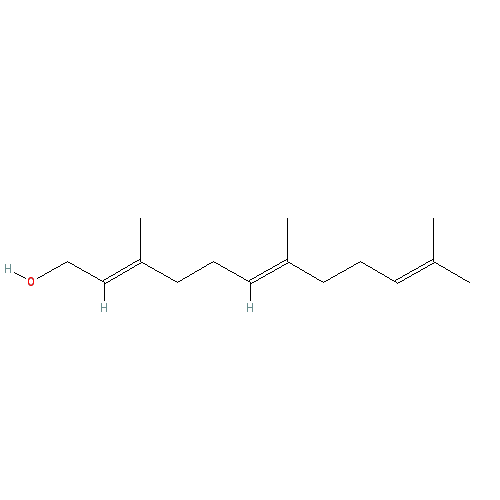
3,7,11-Trimethyl-2,6,10-dodecatrien-1-ol
(2E,6E)-Farnesol · trans,trans-Farnesol
化学組成 · Constituent
Farnesol is a sesquiterpene alcohol occurring mainly in ambrette and Western Australian sandalwood oils. The EU lists it as one of 26 fragrance allergens requiring declaration.
Skin. A 5 percent patch test across three groups of more than 300 volunteers produced no irritation or sensitization. In maximation tests, 5 percent of healthy individuals showed allergic reactions to farnesol at 10 to 12 percent. Undiluted material caused reactions in 14.7 percent of individuals.
Dermatitis patients. Reaction rates to 5 percent farnesol vary from 0.4 to 1.2 percent in large European studies. Several cases of axillary dermatitis have been reported in young women using farnesol-containing deodorants.
Oral and dermal. Acute oral LD50 in rats exceeds 5 g/kg, in mice 8.76 g/kg. Acute dermal LD50 in rabbits exceeds 5 g/kg.
Subchronic. A 28-day oral study at 500 to 1,000 mg/kg/day in rats showed no clinical toxicity. Increased kidney and liver weights were attributed to induction of drug-metabolizing enzymes.
Mutagenicity and cancer. Not mutagenic in Ames or micronucleus tests. Significant anticancer activity against melanoma, pancreatic, leukemia and oral squamous carcinoma cells.
| Ambrette | 3.4 – 39.0 % |
| Sandalwood (Western Australian) | 7.9 – 9.3 % |
| Palmarosa | 0.5 – 6.1 % |
| Neroli | 0 – 3.2 % |
| Vassoura | 5.5 % |
| Rose (Japanese) | 3.8 % |
| Galangal (greater) | 0 – 3.1 % |
| Cabreuva | 2.5 % |
| Rose (Damask) | 0 – 1.5 % |
| Rose (Provence) | 0.5 – 1.3 % |
| Tuberose | 1.7 % |
After oral administration of a mixture of farnesol isomers in rats, 80 percent of farnesol recovered in plasma was the (2E,6E)-isomer. A 28-day oral course significantly increased the activities of several liver enzymes including CYP1A, CYP2A1-3, CYP2B1/2, CYP2E1, CYP3A1/2, glutathione reductase and UGT.
Farnesol is sometimes used as a bacteriostat as well as a fragrance material in deodorants. The real-world risk of skin sensitization from farnesol in essential oils is low.