β-Caryophyllene
[1R-(1R*,4E,9S*)]-4,11,11-Trimethyl-8-methylenebicyclo[7.2.0]undec-4-ene
trans-Caryophyllene · Caryophyllene
化学組成 · Constituent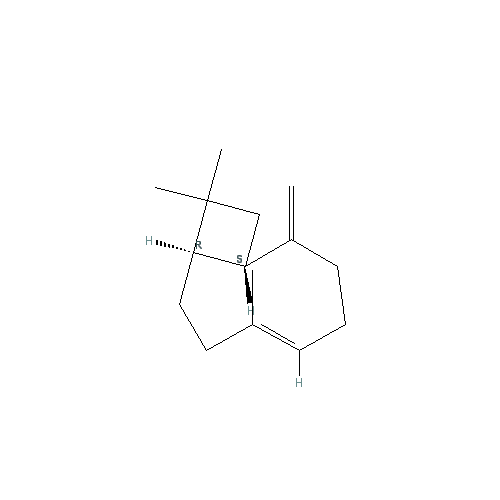
[1R-(1R*,4E,9S*)]-4,11,11-Trimethyl-8-methylenebicyclo[7.2.0]undec-4-ene
trans-Caryophyllene · Caryophyllene
化学組成 · Constituent
β-Caryophyllene is among the most common sesquiterpenes in essential oils, particularly in copaiba, black pepper and clove. The compound is a weak skin allergen and oxidation does not increase its allergenicity.
Skin. β-Caryophyllene oxidizes readily in air, with only 50 percent of the original compound remaining after 6 weeks; caryophyllene oxide is the major product. After 10 weeks of air exposure, β-caryophyllene shows only weak sensitizing capacity in a local lymph node assay.
Among 1,511 consecutive dermatitis patients, two (0.14 percent) reacted to 3.9 percent oxidized β-caryophyllene (containing 25 percent β-caryophyllene and 75 percent caryophyllene oxide).
Oral. Acute oral LD50 in rats exceeds 5 g/kg; rabbit dermal LD50 exceeds 5 g/kg.
Mutagenicity. Non-mutagenic in Salmonella TA98 and TA100, antimutagenic in several assays. Non-genotoxic in the mouse bone marrow micronucleus test.
Anticancer. Significant glutathione S-transferase induction in mouse liver and small intestine; moderate cytotoxicity against multiple cancer cell lines. Increased survival in ascites tumor mice after four intraperitoneal doses of 20 mg/kg.
β-Caryophyllene is a CB2 agonist, studied for anti-inflammatory activity.
| Copaiba | 24.7 – 53.3 % |
| Cananga | 38.2 % |
| Pepper (black) | 9.4 – 30.9 % |
| Cangerana | 28.6 % |
| Catnip | 6.2 – 24.6 % |
| Fern (sweet) | 24.5 % |
| Pepper (white) | 23.4 % |
| Ylang-ylang | 1.1 – 21.5 % |
| Melissa | 0.3 – 19.1 % |
| Camphor (Borneo) | 18.1 % |
| Fenugreek | 14.6 % |
| Clove stem | 3.5 – 12.4 % |
| Clove bud | 0.6 – 12.4 % |
| Lantana | 12.0 % |
| Pine (black) | 5.3 – 11.8 % |
| Myrtle (bog) | 11.0 % |
| Sage (Dalmatian) | 0.2 – 9.7 % |
| Curry leaf | 7.3 % |
| Pimento berry | 4.0 – 6.6 % |
| Clove leaf | 3.5 – 6.4 % |
| Lavender | 1.8 – 5.9 % |
| Cinnamon bark | 1.3 – 5.8 % |
| Carrot seed | 0.7 – 5.6 % |
β-Caryophyllene is the key carrier of the woody-spicy notes of black pepper and clove. Its CB2 activity is under study for anti-inflammatory and pain applications.
Sealed and cool storage matters because of rapid oxidation to caryophyllene oxide.