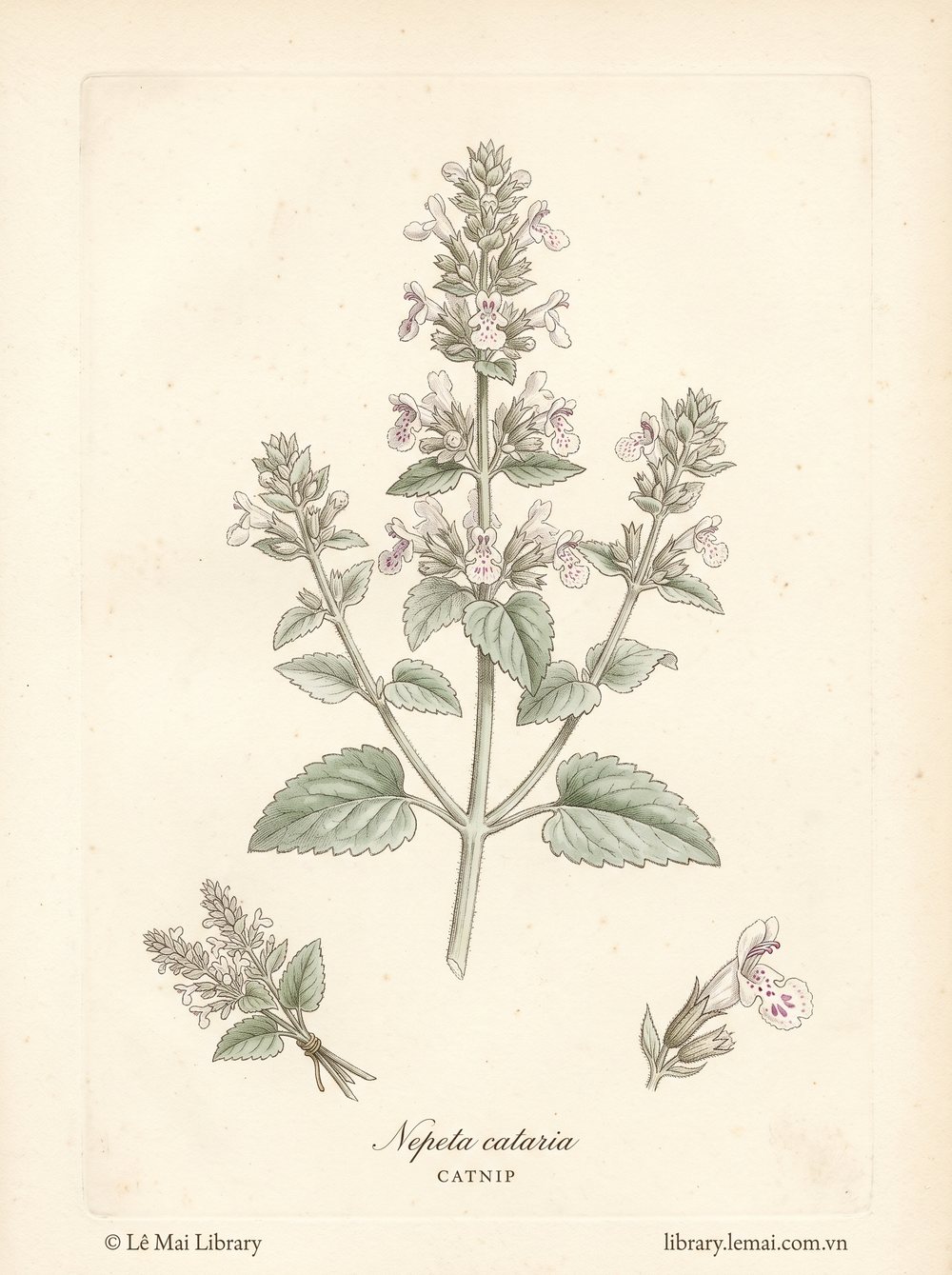
キャットニップ
Bạc hà mèo
Nepeta cataria
Catmint, Catnep
Low risk of skin sensitization. May be psychotropic.
Caution with oral administration.
Dried catnip leaves given to mice (10 percent of diet) for one day caused increased seizure susceptibility, decreased sleep duration and increased stereotyped behavior. Seven days of feeding induced tolerance to these effects.
Mild and transient psychotropic effects in humans have been reported after smoking the dried herb, similar to but milder than cannabis (euphoria, mood elevation, a sense of unreality, visual hallucinations).
In rodents, epinepetalactone (a stereoisomer of nepetalactone) inhibited PTZ-induced seizures. Catnip oil is therefore not certainly neurotoxic.
| Nepetalactone isomers | 12.7 – 84.0 % |
| Nepetalic acid | 1.2 – 43.0 % |
| Dihydronepetalactone | 0 – 25.0 % |
| β-Caryophyllene | 6.2 – 24.6 % |
| Caryophyllene oxide | 14.3 – 19.4 % |
| (E)-β-Farnesene | 0 – 2.1 % |
| Humulene oxide | 1.0 – 1.6 % |
| Piperitone | 0 – 1.5 % |
| α-Caryophyllene | 0 – 1.3 % |
| β-Elemene | 0 – 1.2 % |
Nepeta cataria is a perennial herb of temperate Europe and Asia, naturalized in North America. The aerial parts are distilled for the oil.
The herb is a strong attractant for domestic cats, it needs only to be smelled (not ingested) to influence cat behavior.
The constituent data suggest at least two chemotypes: a nepetalic acid CT and a β-caryophyllene CT, both nepetalactone-rich. Commercial catnip oils contain two isomers of nepetalactone, (Z,E)- and (E,Z)-. Other chemotypes exist with different nepetalactones.
Catnip has traditional uses for restlessness, nervous headache, anxiety, and hysteria. Said to induce sleep. Modern medical research on the essential oil is limited, only the insect-repellent capacity has been studied.