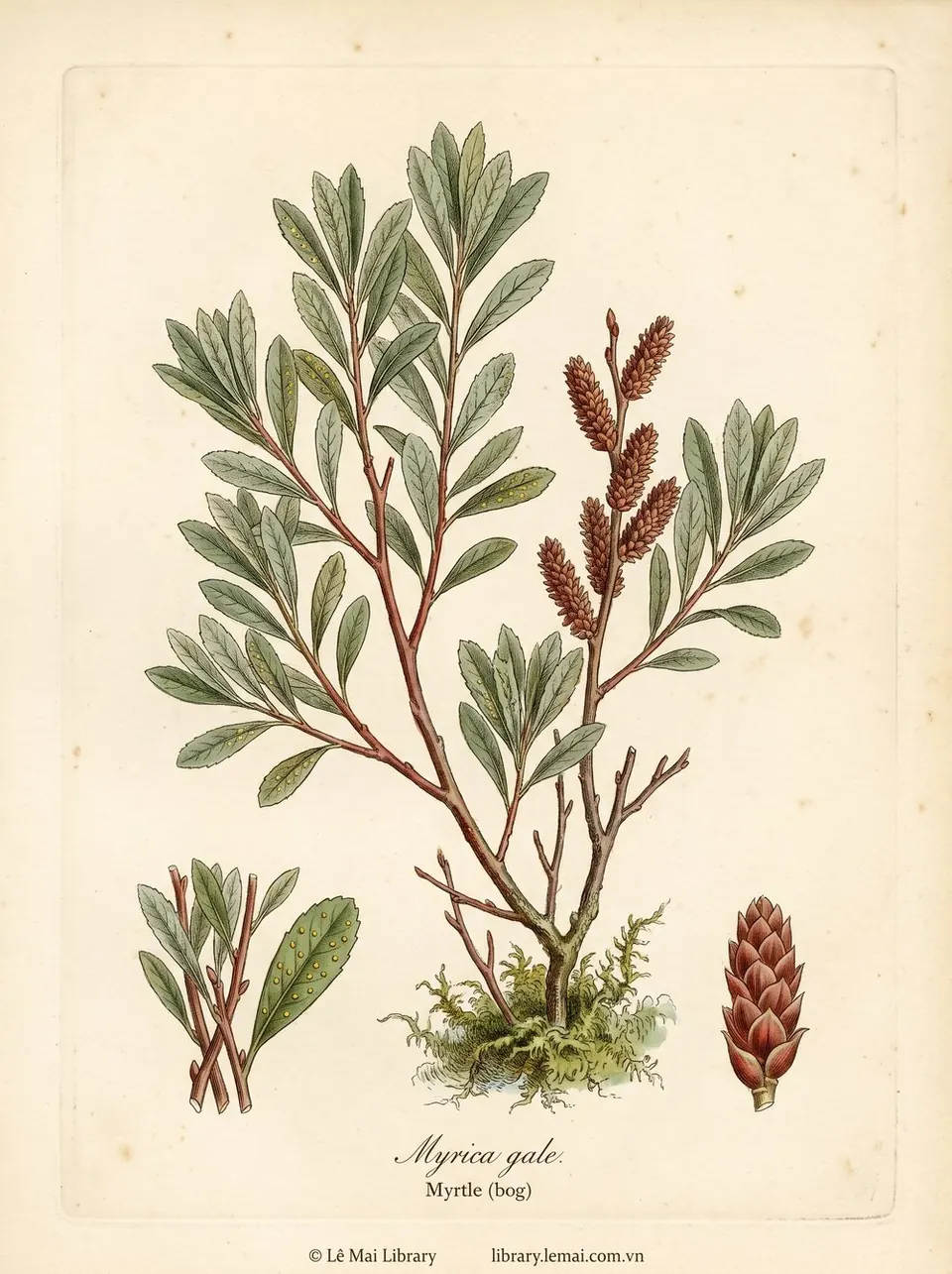
ボグミルトル
Sim đầm lầy
Myrica gale
Bog myrtle, Sweet gale
Bog myrtle essential oil is steam-distilled from the leaves and young branches of Myrica gale, a small shrub of northern wetlands in Scotland, Scandinavia and North America; despite the name, it belongs to the bayberry family, not the myrtle family. It smells cool, green and slightly piney; its main components are α-phellandrene (about 20 to 35%) and α-pinene. Once used to flavor gruit beer, it now suits soap, candles and room fragrance.
Updated 6 Nov 2026 · Lê Mai Team
Low risk of skin sensitization. Phellandrene and α-pinene dominant.
Monoterpene oxidation products may sensitize. Store properly.
No data indicates hazard in pregnancy.
| α-Phellandrene | 20.0 – 35.0 % |
| α-Pinene | 10.0 – 20.0 % |
| 1,8-Cineole | 5.0 – 12.0 % |
| (+)-Limonene | 5.0 – 10.0 % |
| p-Cymene | 3.0 – 8.0 % |
Myrica gale is a small shrub growing in northern hemisphere wetlands, Scotland, Scandinavia, North America, Russia.
Traditionally used as a beer flavoring ('gruit') before hops became widespread.
Family Myricaceae, not Myrtaceae as the name might suggest.
Very small-scale, niche production. In perfumery, bog myrtle contributes a cool, green, slightly piney note.
Has a long tradition of use in Scotland.