Myristicin
3-Methoxy-4,5-(methylenedioxy)-1-(2-propenyl)benzene
Methoxysafrole · 3-Methoxy-4,5-(methylenedioxy)allylbenzene
化学組成 · Constituent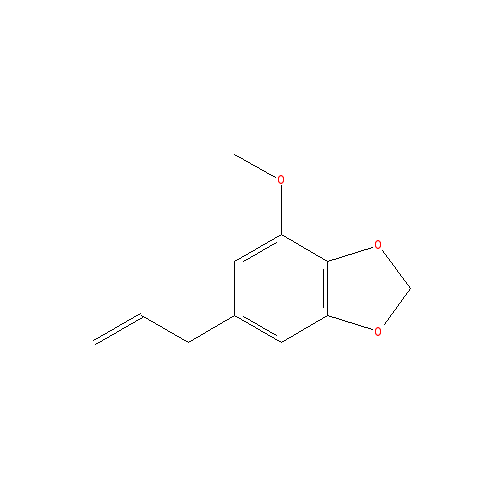
3-Methoxy-4,5-(methylenedioxy)-1-(2-propenyl)benzene
Methoxysafrole · 3-Methoxy-4,5-(methylenedioxy)allylbenzene
化学組成 · Constituent
Myristicin is a phenylpropenoid ether present at high levels in parsnip, parsley seed and nutmeg. The compound inhibits MAO and induces several CYP enzymes and glutathione S-transferase, suggesting potential drug interactions.
Acute toxicity. Cat oral LD100 is 570 mg/kg. Myristicin is believed to be especially toxic to cats. The odor of nutmeg repels cats.
Drug interactions. Myristicin is a moderate MAO inhibitor in rodents. Oral use of myristicin-rich oils therefore warrants caution in those taking MAOIs, SSRIs, pethidine and indirect sympathomimetics.
Neurological. Myristicin can reproduce many psychotropic properties of ground nutmeg and increases serotonin levels in rat brain. A proposed metabolic pathway converts myristicin to TMA or MMDA, known hallucinogens. However, there is no evidence of in vivo conversion to either. A 400 mg oral human dose produces no psychotropic effect.
Liver. Myristicin was found to possess 'extraordinarily potent hepatoprotective activity' in rats against liver damage caused by lipopolysaccharide or D-galactosamine.
Mutagenicity. Non-genotoxic in Chinese hamster ovary cells. In two 32P post-labelling studies, low but possibly significant DNA adduct formation was reported in newborn and adult mice. Adduct binding is 3 to 4 times weaker than safrole.
Cancer. In a novel carcinogen assay, myristicin is weakly hepatocarcinogenic in male rats. Not carcinogenic in mice given an ip dose of 912 mg. The compound inhibits benzo[a]pyrene-induced tumors in mice and is cytotoxic to neuroblastoma SK-N-SH cells through an apoptotic mechanism.
| Parsnip | 17.2 – 40.1 % |
| Parsley seed | 0.7 – 37.9 % |
| Nutmeg (East Indian) | 3.3 – 13.5 % |
| Parsley leaf | 1.9 – 8.8 % |
| Mace | 1.3 – 5.9 % |
| Sugandha | 2.5 % |
| Nutmeg (West Indian) | 0.5 – 0.9 % |
In rats, the methylenedioxy group of myristicin is particularly susceptible to cleavage, producing catechol derivatives. Alcohol and carboxylic acid oxidation products were also identified in rat urine.
In human liver, the major metabolite is 5-allyl-1-methoxy-2,3-dihydroxybenzene, with CYP3A4 and CYP1A2 as the primary enzymes. Myristicin induces glutathione S-transferase up to 14-fold and is a potent inducer of CYP P448.
Non-alcoholic drinks, especially cola, are a major source of human myristicin intake.
Total myristicin intake from essential oils and spices in food does not cause significant adverse effects in humans under normal conditions. However, due to its actions on MAO and CYP activity, myristicin-rich oils should be used cautiously or avoided in people taking prescription drugs.