Methyleugenol
3,4-Dimethoxy-(2-propenyl)benzene
O-Methyleugenol · Eugenol methyl ether · 4-Allylveratrole
化学組成 · Constituent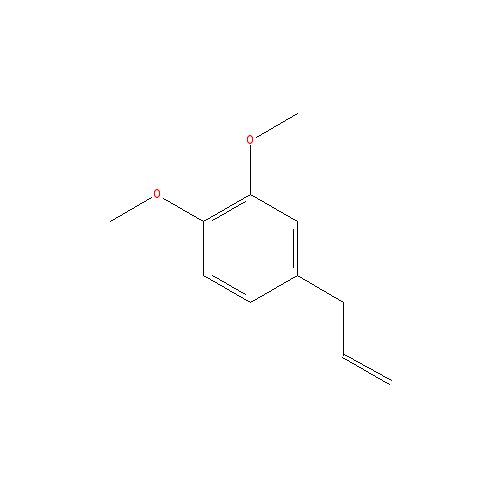
3,4-Dimethoxy-(2-propenyl)benzene
O-Methyleugenol · Eugenol methyl ether · 4-Allylveratrole
化学組成 · Constituent
Methyleugenol is a phenylpropenoid ether classed by NTP as 'reasonably anticipated to be a human carcinogen' based on sufficient evidence of carcinogenicity in experimental animals. The Council of Europe lists it among substances suspected of being genotoxic carcinogens for which no MDI can be set.
Skin. An 8 percent test on 25 volunteers caused no irritation and no sensitization. In a worldwide multicenter study on 218 dermatitis patients with proven fragrance sensitization, 4 (1.8 percent) reacted to 5 percent methyleugenol.
Acute toxicity. Acute oral LD50 in rats 810 to 1,560 mg/kg. Acute dermal LD50 in rabbits exceeded 5 g/kg. The acute NOAEL was estimated at 10 mg/kg in rats and mice.
Hepatic and gastrointestinal toxicity. In 14-week and 90-day oral studies, methyleugenol altered protein, carbohydrate and fat metabolism, raised alanine aminotransferase and sorbitol dehydrogenase, caused hepatocellular changes and gastric mucosal atrophy. The rat 90-day NOAEL is 10 mg/kg.
Reproductive. Pregnant rats given 80, 200, 500 mg/kg/day on gestational days 6 to 19 showed mid- and high-dose reductions in maternal weight gain and mild hepatotoxicity. Developmental toxicity NOAEL was 200 mg/kg, but one type of skeletal abnormality increased at the high dose.
Mutagenicity. Methyleugenol was mutagenic in the Bacillus subtilis DNA repair test and Saccharomyces cerevisiae, but negative in the Ames test. When human sulfotransferases were expressed in S. typhimurium TA100, the compound formed DNA adducts. Methyleugenol is genotoxic in rat hepatocytes and forms adducts with DNA and proteins in rats and mice.
Cancer. In a two-year study on F344 rats and B6C3F1 mice, methyleugenol given by gavage at 37, 75 or 150 mg/kg/day five days per week produced clear evidence of carcinogenesis in all groups. Significant increases in liver and glandular stomach tumors occurred in both sexes. The NOAEL for some tumor types was 37 mg/kg/day.
Safety recommendation. 90-day NOAEL 10 mg/kg/day, reduced 10-fold for lifetime exposure to 1 mg/kg/day. With 5-fold human variability, taking 0.05 mg/kg/day and applying a 5-fold factor gives 0.01 mg/kg/day, equivalent to 0.02 percent dermal.
| Tea tree (black) | 97.7 % |
| Pine (huon) | 95.0 – 97.0 % |
| Snakeroot | 36.1 – 44.5 % |
| Pimento berry | 2.9 – 13.1 % |
| Pteronia | 7.2 % |
| Basil (estragole CT) | 0 – 4.2 % |
| Laurel leaf | 1.4 – 3.8 % |
| Rose (Damask) | 0.5 – 3.3 % |
| Champaca (white) | 2.3 % |
| Calamus (tetraploid form) | tr – 2.0 % |
| Pimento leaf | tr – 1.9 % |
| Tuberose | 1.7 % |
| Betel | 0.3 – 1.7 % |
| Citronella | 0 – 1.7 % |
| Hyacinth | 1.5 % |
| Tarragon | 0.1 – 1.5 % |
| Chaste tree | 0 – 1.5 % |
| Bay (West Indian) | 0 – 1.4 % |
| Nutmeg (East Indian) | 0.1 – 1.2 % |
| Myrtle | 0.3 – 1.0 % |
The major metabolic route in rats involves modification of the propenyl group rather than the methoxy groups. Principal products include 2'-hydroxy-3,4-dimethoxyphenylpropanoic acid, 3,4-dimethoxycinnamic acid and 3,4-dimethoxybenzoic acid.
Hydroxylation yields 1'-hydroxymethyleugenol, which can be further metabolized to 1'-sulfooxymethyleugenol, the likely ultimate carcinogen. The rate of 1'-hydroxylation in human livers varies up to 27-fold among individuals, but most fall within the rat-equivalent range.
Human dermal absorption is estimated at 2 to 5 percent based on permeability coefficients. Methyleugenol was detected in serum of 98 percent of 206 samples from US adults at a mean concentration of 24 pg/g.
Methyleugenol is structurally close to estragole and safrole, all three carcinogenic phenylpropenoids. Comparison of DNA adducts and BMDL10 values shows no major difference in carcinogenic potential among the three compounds.
Modern essential oil suppliers offer rose and several others that have been selected to reduce methyleugenol content. In standard oils, the compound appears at very low levels in rose, nutmeg, basil and others.