Elemicin
3,4,5-Trimethoxy-1-(2-propenyl)benzene
3,4,5-Trimethoxy-1-allylbenzene
化学組成 · Constituent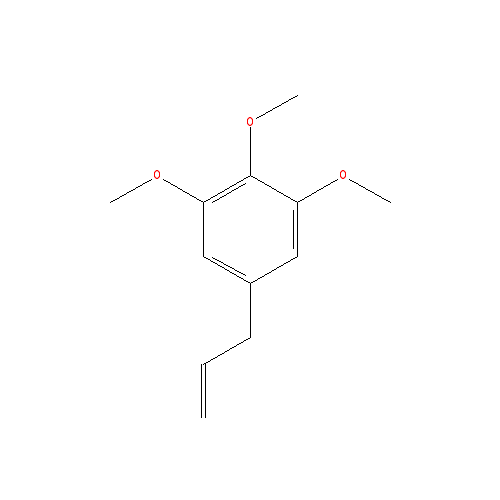
3,4,5-Trimethoxy-1-(2-propenyl)benzene
3,4,5-Trimethoxy-1-allylbenzene
化学組成 · Constituent
Elemicin is a phenylpropenoid related to myristicin and may contribute to the psychotropic effects of nutmeg. The Council of Europe lists it as a suspected genotoxic carcinogen.
Neurology. Elemicin may be partially responsible for the hallucinogenic properties of nutmeg. A theoretical metabolic pathway can convert elemicin and myristicin to TMA or MMDA, both known hallucinogens. However, elemicin per se is insufficiently potent to explain the psychotropic effects of nutmeg.
Mutagenicity. Results are inconsistent. Some studies show elemicin to be antimutagenic, others suggest low to moderate or significant genotoxicity.
Cancer. In male mice, elemicin was not carcinogenic at a total ip dose of 1.0 mg. However, the metabolite 10-hydroxyelemicin produced hepatomas at higher doses. No long-term studies in rats or female mice are available.
| Elemi | 1.8 – 10.6 % |
| Parsley seed | 0 – 8.8 % |
| Nutmeg (East Indian) | 0.1 – 4.6 % |
| Mace | 0.2 – 3.1 % |
| African bluegrass | 1.8 – 2.7 % |
| Thorow-wax | 2.0 % |
| Snakeroot | 0 – 1.8 % |
| Nutmeg (West Indian) | 1.2 – 1.4 % |
Elemicin in rats undergoes two main biotransformations: oxidation to 3-(3,4,5-trimethoxyphenyl)-propionic acid and 3-(3,4,5-trimethoxyphenyl)-propane-1,2-diol. Small amounts of the epoxide of the 3-O-demethylated derivative are also formed. After nutmeg ingestion, the metabolites O-demethyl elemicin and O-demethyl dihydroxy elemicin appear in human urine.
Elemicin together with myristicin and safrole are the three major phenylpropenoids in nutmeg, contributing to both the aroma and the toxicology profile of the oil.