α-Phellandrene
2-Methyl-5-(1-methylethyl)-1,3-cyclohexadiene
p-Mentha-1,5-diene
化学組成 · Constituent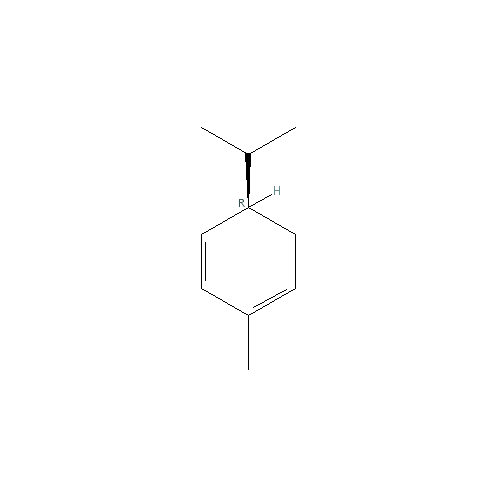
2-Methyl-5-(1-methylethyl)-1,3-cyclohexadiene
p-Mentha-1,5-diene
化学組成 · Constituent
α-Phellandrene is a monoterpene hydrocarbon prone to oxidation. Fresh material poses low risk, while oxidized material can become a skin sensitizer.
Skin. Undiluted material was moderately irritating to rabbit skin. At 4 and 8 percent on 25 volunteers it was not irritating. At 8 percent it was not sensitizing. At 4 percent one positive reaction occurred in 25 volunteers, attributed to autoxidation. At 5 percent it sensitized 4 of 11 dermatitis patients already sensitized to tea tree oil.
Oral. Acute oral LD50 in rats was 5.7 g/kg, a high value. Acute dermal LD50 in rabbits exceeded 5 g/kg. Oral overdose can cause vomiting and diarrhea.
Mutagenicity and cancer. Not genotoxic in Chinese hamster ovary cells. Reports indicate promotion of tumor formation on the skin of mice pretreated with the primary carcinogen DMBA, although α-phellandrene itself is not carcinogenic.
| Turmeric leaf | 53.4 % |
| Dill weed | 18.2 – 30.2 % |
| Angelica root | 7.5 – 20.0 % |
| Pepper (pink) | 5.3 – 17.3 % |
| Eucalyptus (peppermint) | 16.9 % |
| Elemi | 4.3 – 15.1 % |
| Turmeric rhizome | 0.7 – 12.8 % |
| Goldenrod | 11.9 % |
| Turpentine | 0 – 8.0 % |
| Lemon balm (Australian) | 7.1 % |
| Dill seed (Indian) | tr – 6.5 % |
| Nutmeg (East Indian) | 0.4 – 5.8 % |
| Peta | 5.5 % |
α-Phellandrene is metabolized in sheep along at least two pathways. One involves reduction and oxidation yielding phellandric and phellanduric acids. The other involves hydroxylation and glucuronide conjugation. Both p-cymene and carvotanacetone are found in the conjugate.
α-Phellandrene shares the typical oxidation risk of the monoterpene group, like α-pinene and 3-carene. Oils high in α-phellandrene should be refrigerated and kept tightly sealed.