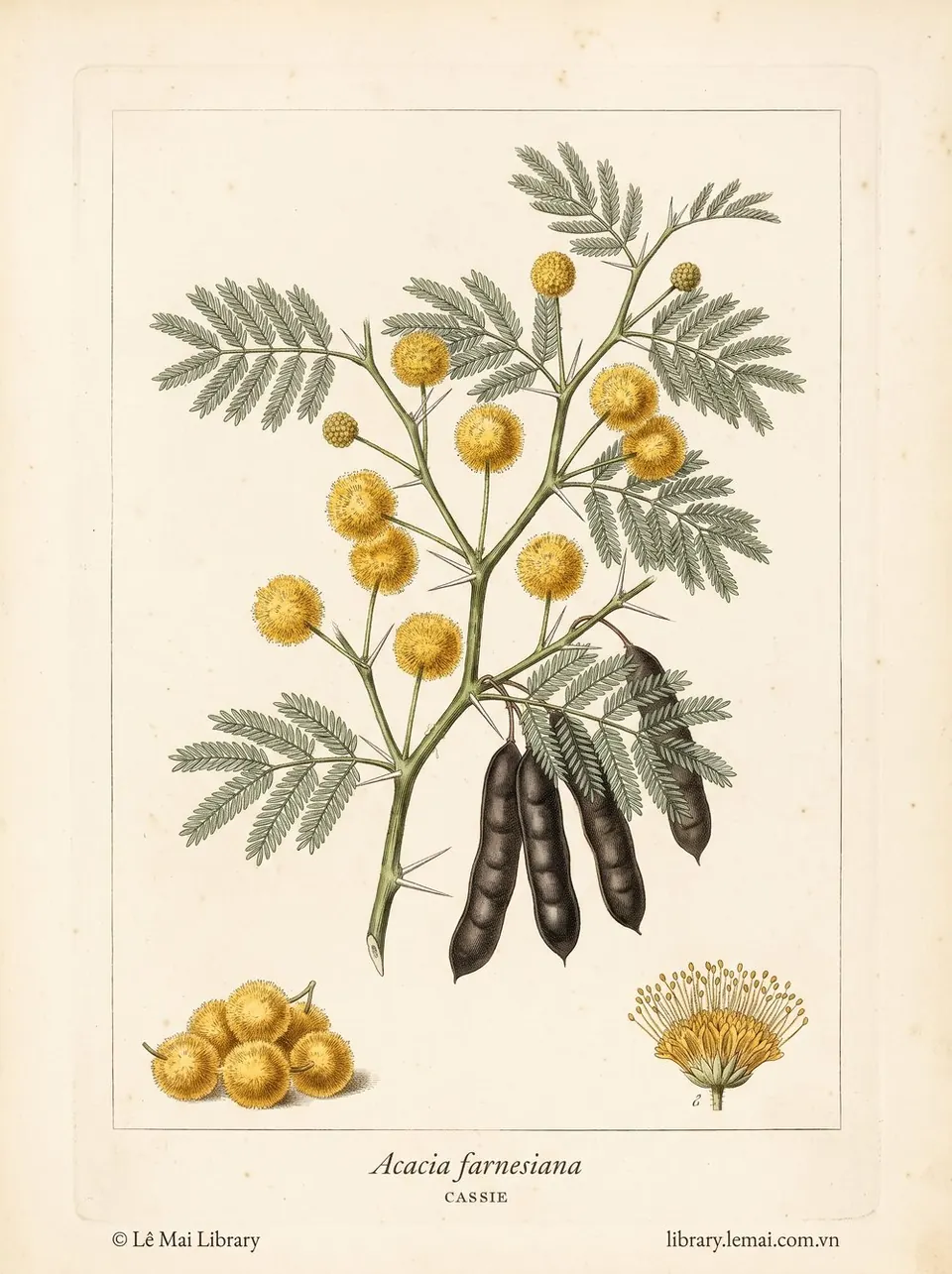
カシー
Hoa Cassie
Acacia farnesiana
Cassie absolute is solvent-extracted from the flowers of Acacia farnesiana, a small Central American shrub with round yellow flowers, in the mimosa family. Its main components include p-anisaldehyde, benzyl alcohol and farnesol. Only about 25% of the absolute is volatile, the rest being waxes, and it is used mainly in powdery floral perfumes.
Updated 6 Nov 2026 · Lê Mai Team
No specific contraindications in available data.
Methyl salicylate is below 5 percent, requiring no specific limit.
Non-phototoxic. No irritation or sensitization at 4 percent test level.
| Methyl salicylate | < 5.0 % |
| p-Anisaldehyde | Major |
| Benzyl alcohol | Major |
| Farnesol | Major |
| Geraniol | Major |
| Benzaldehyde | Minor |
| Benzoic acid | Minor |
| Geranyl acetate | Minor |
| α-Ionone | Minor |
| β-Ionone | Minor |
| Linalool | Minor |
| Linalyl acetate | Minor |
| Nerolidol | Minor |
Acacia farnesiana is a small shrub of Central America, with rounded yellow flowers carrying a deep, warm scent reminiscent of violet and honey.
The absolute is solvent-extracted. Contains around 25 percent volatile constituents, with the remainder being waxes and heavier compounds.
Family Mimosaceae. The name 'cassie' follows traditional French perfumery convention.
May be adulterated with mimosa absolute and synthetic materials.
Costly absolute, rarely used at significant concentration.