α-Ionone
(3E)-4-(2,6,6-Trimethyl-2-cyclohexen-1-yl)-3-buten-2-one
Parmone · 4,7-Megastigmadien-9-one
化学組成 · Constituent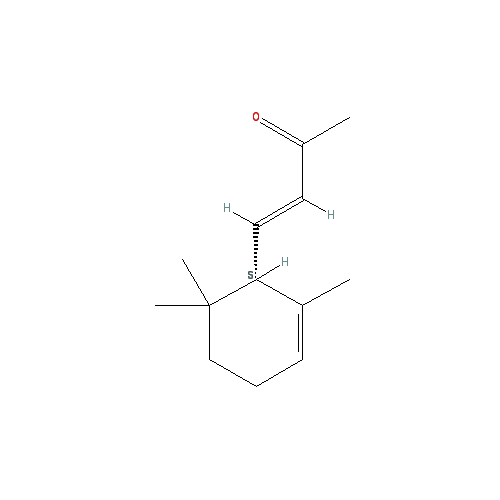
(3E)-4-(2,6,6-Trimethyl-2-cyclohexen-1-yl)-3-buten-2-one
Parmone · 4,7-Megastigmadien-9-one
化学組成 · Constituent
α-Ionone is the principal constituent of violet aroma in perfumery. It occurs at low levels in osmanthus and champaca absolutes.
Skin. Patch tests on 25 volunteers with undiluted ionone (a mixture of α and β) caused no irritation, and at 8 percent no sensitization. A 48-hour patch test at 32 percent in acetone caused moderate irritation. In 100 consecutive dermatitis patients, no reactions occurred at 1 percent.
Oral. Acute oral LD50 in mice is 6.6 to 7.0 g/kg.
Subchronic. A 90-day study at 10 or 100 mg/kg/day established a NOAEL of 10 mg/kg. In another 12-week study the NOAEL was 10.6 mg/kg.
Mutagenicity. Not mutagenic in the Ames test, weakly genotoxic in Chinese hamster cells, not genotoxic in micronucleus tests.
| Osmanthus | tr – 2.3 % |
| Champaca (orange) | 0.1 – 1.6 % |
α-Ionone metabolism involves oxidation, reduction and glucuronide conjugation. The compound induces CYP1A and CYP2B.
α-Ionone and β-ionone are the ionone pair responsible for violet aroma, produced synthetically at large scale for perfumery. Natural ionone is rare and precious, found mainly in osmanthus.