Methyl salicylate
Methyl 2-hydroxybenzoate
2-Hydroxybenzoic acid methyl ester · Wintergreen oil constituent
化学組成 · Constituent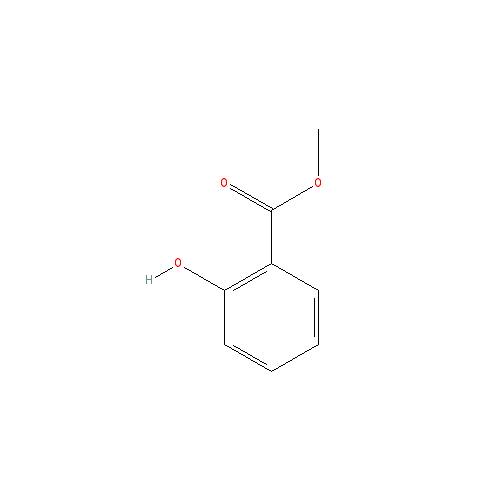
Methyl 2-hydroxybenzoate
2-Hydroxybenzoic acid methyl ester · Wintergreen oil constituent
化学組成 · Constituent
Methyl salicylate is the dominant constituent of wintergreen and sweet birch oils, often over 90 percent. The compound carries serious acute toxicity risk and significant drug interactions. Actual human poisoning levels exceed predictions from animal data.
Skin. Undiluted methyl salicylate was moderately irritating to rabbit skin. An 8 percent test on 25 volunteers caused no irritation and no sensitization. At 30 or 60 percent on 9 volunteers, it was irritating. Across thousands of dermatitis patients, average allergic reaction rate to 2 percent was 0.33 percent.
Acute toxicity. Adult oral LD50 estimated at 500 mg/kg, child LDlo 170 mg/kg. A 4 mL dose of methyl salicylate has been fatal in infants. One teaspoon (5 mL) is equivalent to approximately 7.0 g of salicylate, or 21.7 adult aspirin tablets. Oral ingestion has been the cause of many accidental child deaths.
Drug interactions. Topical methyl salicylate can potentiate warfarin's anticoagulant effect, causing internal hemorrhage. A 22-year-old presented with elevated INR after applying methyl salicylate-containing gel to knees daily for 8 days.
Reproductive. Salicylates cause dose-dependent congenital abnormalities in animals and cross the placenta. Ip injection of 200 or 400 mg/kg in pregnant rats on gestational days 9 and 10 caused reduced development of fetal brain, liver, lung and kidney. Topical application of undiluted 2 g/kg on rats killed 25 percent of mothers and resorbed 100 percent of embryos.
Cardiovascular. Applying 5 g of a 30 percent methyl salicylate preparation caused significant platelet inhibition after 6 hours, equivalent to ingesting 162 mg of aspirin.
Mutagenicity and cancer. Non-genotoxic in Chinese hamster cells, non-mutagenic in the Ames test. In a mouse study, ip injection of methyl salicylate did not increase lung tumor incidence.
Safety recommendation. Proposed maximum oral dose 2.5 mg/kg/day, based on rat 3-generation reproductive NOAEL of 25 mg/kg with uncertainty factor 10. Equivalent to dermal limit 2.4 percent.
| Wintergreen | 96.0 – 99.5 % |
| Birch (sweet) | 90.4 % |
| Ylang-ylang | 0 – 10.4 % |
| Tuberose | 8.4 % |
| Cassie | < 5.0 % |
| Bakul | 1.9 % |
After topical application, methyl salicylate is extensively metabolized to salicylic acid in human dermal and subcutaneous tissues. Oral methyl salicylate is rapidly and extensively hydrolysed to salicylic acid in rats and dogs, more slowly in humans. After oral ingestion of 0.42 mL in 6 volunteers, a mean of 39 percent after 15 minutes and 21 percent after 90 minutes of unchanged methyl salicylate was found in blood.
Significant dermal absorption. In vitro tests on human skin showed 11.0 to 32.0 percent passing through the epidermis. In vivo, dermal absorption is estimated at 12.0 to 20.0 percent over 10 hours. Absorption is higher from lower concentrations.
Transfer into breast milk and other biological fluids. In poisoning cases, methyl salicylate has been detected in saliva, bile, milk, spinal, synovial and peritoneal fluid.
Methyl salicylate is widely used in topical preparations for skin infections and as a counterirritant for rheumatic disorders. Some older sources use 'methyl salicylate' and 'wintergreen oil' as synonyms. As a substituted phenol, methyl salicylate is a weak acid that can be corrosive to tissues.
Methyl salicylate poisoning has a notorious history of poor prognosis. A 1937 report showed 25 of 43 US cases (59 percent) were fatal. In Southeast Asia, inadequate labeling and packaging have led to numerous poisoning cases.