Benzaldehyde
Benzoic aldehyde · Benzenecarbaldehyde · Formyl benzene
化学組成 · Constituent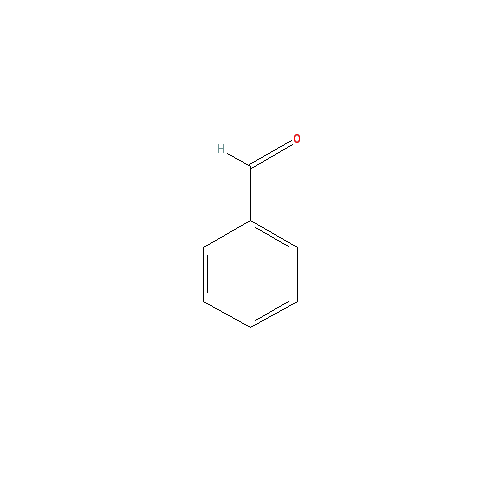
Benzoic aldehyde · Benzenecarbaldehyde · Formyl benzene
化学組成 · Constituent
Benzaldehyde is the defining constituent of bitter almond. The compound is neither a significant skin irritant nor allergen, but vapor can irritate the respiratory tract.
Skin. A 4 percent patch test on two panels of volunteers showed no irritation or sensitization. In 747 fragrance-suspect patients, three (0.4 percent) reacted to 5 percent benzaldehyde.
Oral. Acute oral LD50 is 1.3 g/kg in rats, 1.0 g/kg in guinea pigs. Estimated human oral fatal dose is 50 to 60 mL. Oral 200–400 mg per person in short-term clinical studies showed no toxicity.
Respiratory. Inhalation at 500 ppm caused eye and nose irritation in rabbits; 750 ppm was fatal. RD50 is 363 ppm.
Mutagenicity. Non-mutagenic in the Ames test. CA and SCE results are inconsistent across studies.
Carcinogenicity. In two-year oral studies, benzaldehyde was non-toxic to rats and very weakly carcinogenic to mice, with increased squamous papillomas and forestomach hyperplasia. Benzaldehyde is classified as a mouse-specific, non-genotoxic carcinogen.
Long-term oral 10 mg/kg in humans is established as a safe dose.
| Almond, bitter (FFPA) | 98 % |
| Almond, bitter (unrectified) | 95.0 % |
| Cassia leaf | 1.1 – 6.3 % |
| Cistus | 0 – 2.8 % |
| Cinnamon bark | tr – 2.2 % |
About 90 percent of benzaldehyde is oxidized to benzoic acid and excreted free or as hippuric acid after conjugation with glycine. Rabbits also excrete about 10 percent as benzoyl glucuronide.
The compound is metabolized to benzoic acid directly in the skin. Inhaled benzaldehyde is rapidly absorbed in rats and primarily excreted in urine as hippuric acid.
Benzaldehyde shows substantial anticancer activity in preclinical and clinical studies. In a trial of 102 late-stage cancer patients given a β-cyclodextrin–benzaldehyde inclusion compound, 19 of 57 responded completely and 10 partially, with good tolerability.
The compound is on the FDA Controlled Substances list because it can be used to synthesize methamphetamine.