Eugenol
2-Methoxy-4-(2-propenyl)phenol
2-Methoxy-4-allylphenol · 4-Allylguaiacol · Eugenic acid
化学組成 · Constituent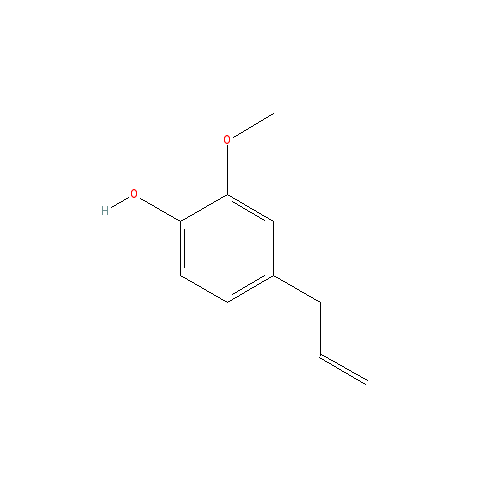
2-Methoxy-4-(2-propenyl)phenol
2-Methoxy-4-allylphenol · 4-Allylguaiacol · Eugenic acid
化学組成 · Constituent
Eugenol is the dominant constituent in clove, cinnamon leaf, pimenta and West Indian bay oils. As a substituted phenol it is a weak acid that can corrode tissues at high concentrations. The EU lists eugenol as one of 26 fragrance allergens requiring declaration.
Skin. An 8 percent patch test on 25 volunteers produced no sensitization. Out of 11,632 patch tests with consumer products containing eugenol or clove leaf oil, only one case of induced and one of pre-existing sensitization were noted. Reaction rates among dermatitis patients vary from 0.4 to 2.0 percent depending on test concentration.
Mucous membranes. Undiluted eugenol causes significant damage to oral and lingual mucosa with cell necrosis. Low doses are anti-inflammatory and locally anesthetic on dental pulp. High concentrations cause cytotoxicity and extensive tissue damage.
Oral. Acute oral LD50 is 2.13 g/kg in guinea pigs, 2.68 g/kg in rats and 3.0 g/kg in mice. Severe poisoning has been reported in children after swallowing 5 to 20 mL of clove oil, with acute liver failure.
Liver. Oral eugenol at 900 mg/kg is hepatotoxic. At 600 mg/kg it may be hepatotoxic in glutathione-depleted mice. At 100 mg/kg it protects the liver from iron overload or carbon tetrachloride damage. The dose-dependent nature is striking.
Drug interactions. Eugenol inhibits human MAO-A, suggesting potential interactions with MAOI and SSRI drugs taken orally. Strong antiplatelet aggregation activity at moderate doses.
Cancer. In a two-year study, eugenol increased liver tumors in male mice, particularly in the low-dose group. Conversely, there is substantial anticancer evidence including inhibition of skin, breast and stomach cancers in animal models.
| Clove bud | 73.5 – 96.9 % |
| Clove leaf | 77.0 – 88.0 % |
| Cinnamon leaf | 68.6 – 87.0 % |
| Clove stem | 76.4 – 84.8 % |
| Pimento leaf | 66.0 – 84.0 % |
| Pimento berry | 67.0 – 80.0 % |
| Tejpat | 78.0 % |
| Basil (pungent) | 62.9 % |
| Bay (West Indian) | 44.4 – 56.2 % |
| Basil (holy) | 31.9 – 50.4 % |
| Betel | 20.5 – 33.2 % |
| Basil (linalool CT) | 9.4 – 15.2 % |
| Cinnamon bark | 2.0 – 13.3 % |
| Carnation | 1.7 – 3.6 % |
| Laurel leaf | 1.2 – 3.0 % |
| Jasmine | 1.1 – 3.0 % |
| Rose (Provence) | 0.7 – 2.8 % |
| Cistus | 0 – 2.3 % |
| Ginger lily | 1.4 % |
| Rose (Damask) | tr – 1.3 % |
| Basil (estragole CT) | tr – 1.2 % |
| Rose (Japanese) | 1.0 % |
| Pine (huon) | 0.5 – 1.0 % |
In humans, eugenol is rapidly absorbed and metabolized. After a 150 mg oral dose, 95 percent is excreted in urine, with about 55 percent as glucuronide and sulfate conjugates. Only 0.1 percent of unchanged eugenol is detected.
Eugenol can be metabolized to toxic compounds including eugenol 2',3'-epoxide and 1'-hydroxyeugenol, analogous to acetaminophen metabolism. However, the epoxide is hydrolyzed much more rapidly in human liver than in rat liver, giving a wide margin of safety in humans.
Epoxidation and 1'-hydroxylation of eugenol are significantly less important than for safrole and estragole, which explains the different cancer profiles among these phenylpropenoids.
Eugenol shows particularly striking dose-dependent behavior. Low concentrations are hepatoprotective, antioxidant and anti-inflammatory. High concentrations act as a pro-oxidant and can cause hepatotoxicity, cytotoxicity and tissue damage.
An interesting observation is that eugenol can reduce skin sensitization to cinnamaldehyde when the two are applied together, possibly through receptor competition or the anti-inflammatory action of eugenol.