Estragole
4-Methoxy-1-(2-propenyl)benzene
O-Methyl chavicol · 4-Allyl anisole · 4-Methoxyallylbenzene
化学組成 · Constituent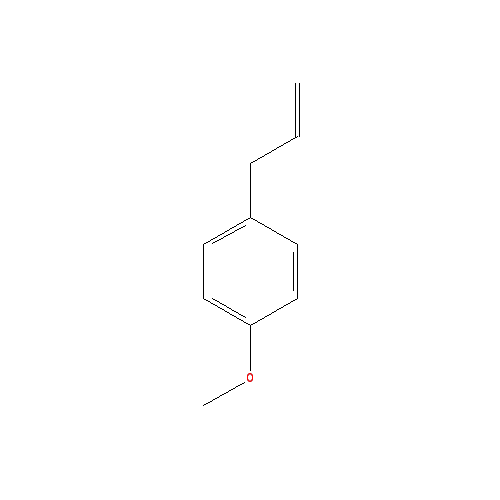
4-Methoxy-1-(2-propenyl)benzene
O-Methyl chavicol · 4-Allyl anisole · 4-Methoxyallylbenzene
化学組成 · Constituent
Estragole is the dominant constituent in tarragon, estragole-CT basil and ravensara bark oils. The compound is a hepatocarcinogen in mice and male rats via the metabolites 1'-hydroxyestragole and its sulfate ester.
Skin. A 3 percent patch test on 25 volunteers produced neither irritation nor sensitization. Applied undiluted to rabbit skin, it was moderately irritating.
Oral. Acute oral LD50 in mice is 1.25 g/kg, in rats 1.82 g/kg. Very high doses induce CNS depression.
Subchronic. A 90-day study at 37.5 to 600 mg/kg/day in rats and mice showed primary toxicity in liver and bile duct. At 300 and 600 mg/kg, all male rats showed bilateral degeneration of testicular germinal epithelium, suggesting male reproductive toxicity at high doses.
Cardiovascular. Estragole shows strong antiplatelet aggregation activity in vitro, reportedly as effective as aspirin.
Mutagenicity and cancer. Estragole is hepatocarcinogenic in male and female mice and in male rats through bioactivation to 1'-hydroxyestragole. The detoxification pathway via O-demethylation is efficient at low doses but is saturated at high doses.
| Ravensara bark | 90.0 – 95.0 % |
| Tarragon | 73.3 – 87.3 % |
| Basil (estragole CT) | 73.4 – 87.4 % |
| Marigold (Mexican) | 84.7 % |
| Chervil | 49.9 – 81.3 % |
| Basil (Madagascan) | 45.0 – 50.0 % |
| Pine (ponderosa) | 22.0 % |
| Basil (holy) | 9.7 – 12.9 % |
| Ravensara leaf | 2.4 – 11.9 % |
| Anise (star) | 0.3 – 6.6 % |
| Fennel (bitter) | 2.8 – 6.5 % |
| Fennel (sweet) | 1.1 – 4.8 % |
| Betel | 0 – 4.8 % |
| Myrtle (aniseed) | 4.4 % |
| Anise | 0.3 – 4.0 % |
| Basil (linalool CT) | 0.2 – 2.0 % |
| Myrtle | 0 – 1.4 % |
| Basil (hairy) | 0.3 – 0.4 % |
| Tea tree (black) | 0.3 % |
| Basil (pungent) | 0.2 % |
| Bay (West Indian) | tr – 0.1 % |
After oral administration in rats, estragole is extensively O-demethylated to chavicol, most of which is excreted unchanged. Other pathways involve oxidation of the allylic side chain by CYP to give 1'-hydroxyestragole and the 2',3'-epoxide, both potentially genotoxic metabolites.
At low doses, epoxidation is minor. At high doses in female rats the metabolic flux shifts toward epoxidation, producing more epoxide and explaining the higher hepatotoxicity. Sulfonation to 1'-sulfooxyestragole is about 30 times more efficient in rat liver than in human liver, suggesting a wide margin of safety in humans.
Individual differences in the isoforms UGT2B7, UGT1A9 and UGT2B15 may make some individuals more at risk than others.
Estragole is structurally close to safrole and methyleugenol, two compounds also with hepatocarcinogenic risk. In star anise and fennel oils, estragole appears alongside (E)-anethole, with markedly different safety profiles between the two.
The compound inhibits platelet aggregation, so oral use of estragole-rich oils warrants caution alongside anticoagulant therapy, before major surgery, childbirth, peptic ulcer or other bleeding disorders.