Cadinene
(1S-cis)-1,2,3,5,6,8a-Hexahydro-4,7-dimethyl-1-(1-methylethyl)-naphthalene (δ-)
Cadina 1(10),4-diene (δ-) · Cadina 4,10(15)-diene (γ-)
化学組成 · Constituent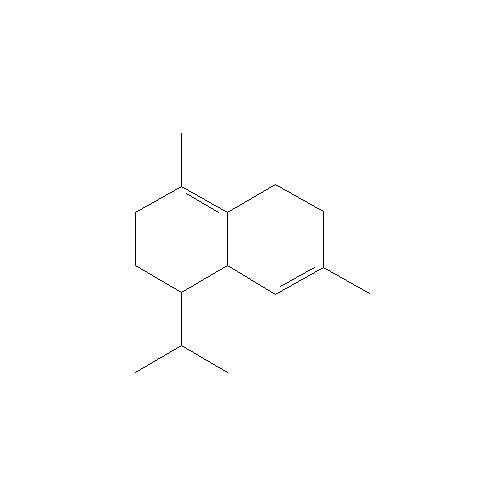
(1S-cis)-1,2,3,5,6,8a-Hexahydro-4,7-dimethyl-1-(1-methylethyl)-naphthalene (δ-)
Cadina 1(10),4-diene (δ-) · Cadina 4,10(15)-diene (γ-)
化学組成 · Constituent
Cadinene exists in multiple isomeric forms, with γ- and δ-cadinene most common; together they occur in over 150 essential oils.
Skin. A 10 percent patch test on 25 volunteers gave no irritation or sensitization.
Oral. Acute oral LD50 in rats exceeds 5 g/kg; rabbit dermal LD50 exceeds 5 g/kg.
Cancer. δ-Cadinene shows moderate in vitro cytotoxicity against two human carcinoma cell lines.
| Siam wood | 15.6 – 32.6 % |
| Cade (rectified) | 24.2 % |
| Hinoki wood | 10.8 – 12.5 % |
| Cedrela | 11.7 % |
| Ylang-ylang | 0.2 – 10.8 % |
| Cubeb | tr – 9.5 % |
| Pine (Scots) | tr – 9.5 % |
| Pepper (pink) | 4.7 – 9.1 % |
| Rhododendron | 9.1 % |
| Cedarwood (Port Orford) | 8.2 % |
| Copaiba | 1.7 – 7.7 % |
| Cangerana | 7.4 % |
| Peta | 7.4 % |
| Manuka | 4.8 – 7.2 % |
| Balsam poplar | 6.9 % |
| Muhuhu | 6.5 % |
| Cananga | 6.0 % |
| Hop | 5.5 % |
| Katrafay | 1.0 – 5.0 % |
| Vassoura | 5.1 % |
The name cadinene derives from the genus Juniperus, where the compound was first isolated. Other isomers including γ1-, γ2-, ε-, σ-, τ- and ω-cadinene have also been reported. ω-Cadinene was originally named δ-cadinene, causing some historical confusion.